
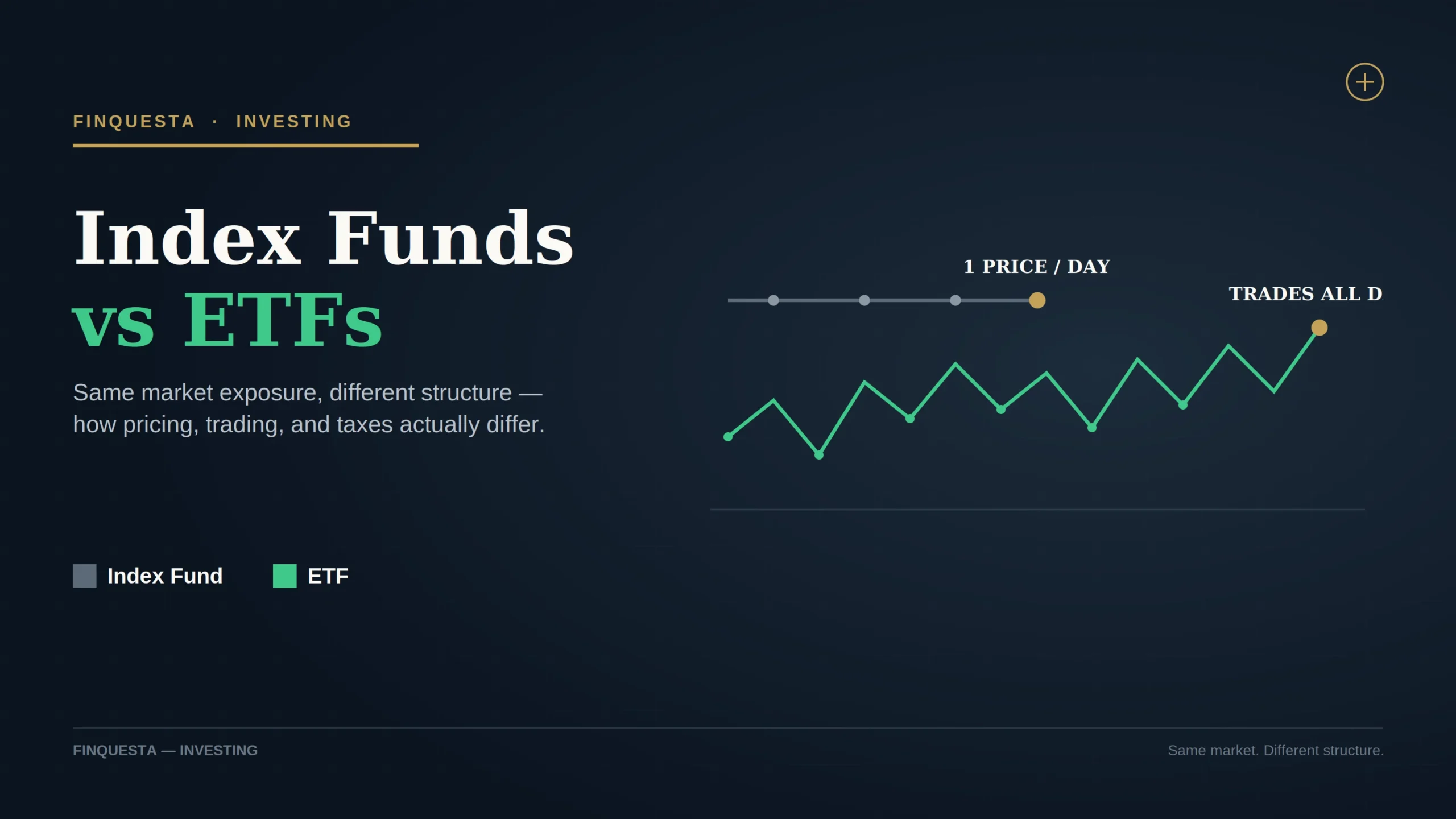
An index fund and an ETF are two different vehicles for buying the same thing: a basket of securities built to track a market index, such as the S&P 500 or the Nifty 50. Both are usually low-cost and passively managed. An index mutual fund trades once a day at its end-of-day price and often has a minimum investment. An ETF trades all day like a stock and needs a brokerage or demat account. Both are regulated — by the SEC in the US, by SEBI in India — and both are common holdings inside retirement accounts.
Table of Contents
Two colleagues, same starting salary, same decision to start investing this month. One opens an account with a fund company and sets up a recurring $300 purchase into an S&P 500 index fund. The other opens a brokerage account and buys shares of an S&P 500 ETF whenever she remembers to. Five years later, both portfolios have grown by roughly the same amount — because they own, almost exactly, the same underlying stocks. The difference between them was never really about performance. It was about structure: how the fund is built, how it’s taxed, and how it fits into the rest of a saver’s financial life.
That’s the part most comparisons skip. They line up expense ratios side by side and call it a day. The more useful question is: given your account type, your trading habits, and where you live, which structure actually removes more friction from your investing life?
What Is an Index Fund?
An index fund is a mutual fund built with one job: hold the same securities, in roughly the same proportion, as a named market index. If the Nifty 50 rises 1.2% on a given day, a Nifty 50 index fund’s underlying portfolio should rise by close to the same amount, minus a small fee. Nobody is picking stocks. There’s no manager trying to beat the market — the fund’s entire strategy is to become the market, as cheaply as possible.
You buy and sell index fund units directly through the fund company (called an AMC — Asset Management Company — in India) or through a brokerage or retirement platform. Orders placed during the day are all filled at the same price: the fund’s Net Asset Value, or NAV, calculated once after markets close. There’s no haggling over price and no bid-ask spread — you get exactly the NAV, whether you buy at 9 a.m. or 3 p.m.
What Is an ETF, Really?
An ETF (exchange-traded fund) is not, strictly speaking, an investment strategy — it’s a wrapper. “ETF” describes how a fund is structured and traded, not what it holds. Most ETFs happen to be index funds in spirit — built to track something like the S&P 500 or a gold price — but the ETF structure itself is neutral. Actively managed ETFs exist too, though they’re a minority of the market.
What makes an ETF an ETF is that its shares list on a stock exchange and trade continuously during market hours, just like a share of Apple or Reliance Industries. You need a brokerage account (in India, a demat and trading account) to hold one. Its price moves in real time based on supply and demand, though authorized participants — large institutional trading firms — work to keep that price closely aligned with the value of the fund’s underlying holdings.
The Core Difference: A Structure, Not a Strategy
It helps to separate two questions that get blurred together: what does the fund own, and how do you buy and sell it? “Index fund” answers the first question — it describes the strategy (track an index passively). “ETF” answers the second — it describes the wrapper (trade on an exchange, all day, like a stock). A Nifty 50 index fund and a Nifty 50 ETF can hold an almost identical basket of 50 stocks. What differs is entirely about the mechanics of buying, selling, pricing, and — as the next two sections show — taxation.
How They’re Priced and Traded
An index mutual fund is priced once per trading day. Every buy or sell order placed before the fund’s daily cutoff time is filled at that day’s closing NAV — the same price for every investor, regardless of when during the day they placed the order.
An ETF trades continuously from market open to close. Its price can differ, sometimes by a small margin, from the value of the assets it holds — this gap is usually tiny for popular, heavily traded ETFs and wider for thinly traded ones. Because ETFs trade like stocks, buying or selling one usually means paying a bid-ask spread — the small gap between what buyers are offering and what sellers are asking. Popular, high-volume ETFs tend to have narrow spreads; low-volume ETFs can have spreads wide enough to meaningfully eat into a small trade.
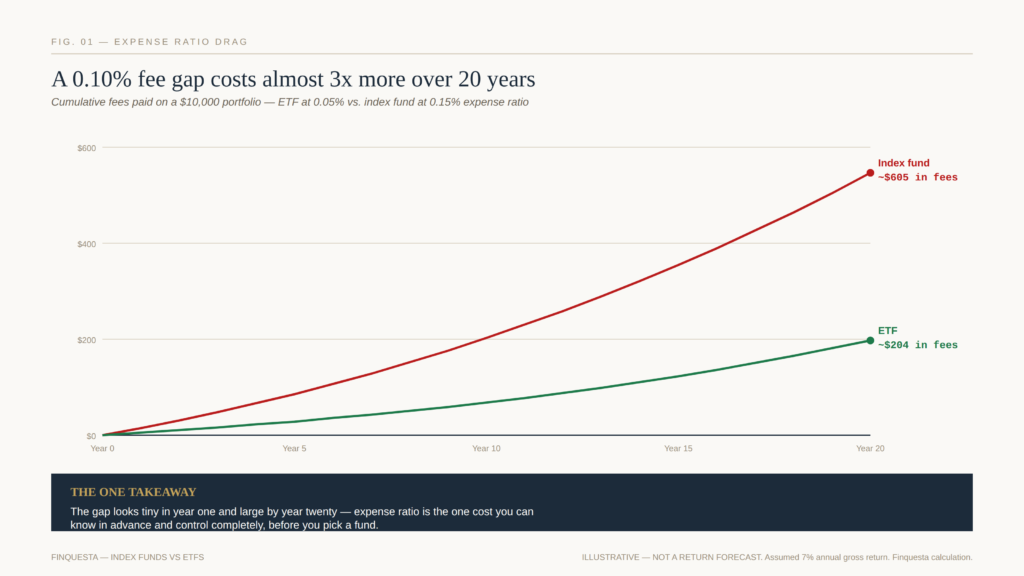
FIG. 01 How a 0.10 percentage-point expense ratio gap compounds over 20 years on a $10,000 portfolio.
Expense Ratios: How Much Does 0.10% Actually Cost You?
On average, ETFs tend to carry slightly lower expense ratios than comparable mutual funds, though the gap has been shrinking for the most popular, heavily traded index products — for widely tracked benchmarks like the S&P 500, the difference between a fund’s ETF share class and its cheapest index-fund share class is often negligible.
The chart above isn’t a real fund’s fee history — it’s a simple compounding calculation, assuming a 7% annual gross return with no other variables changing, comparing a 0.05% expense ratio against a 0.15% one on a $10,000 starting balance. The point isn’t the exact dollar figures; it’s the shape of the curve. A gap that looks trivial in year one — a few dollars — becomes a meaningfully larger sum after two decades of compounding, purely because fees compound too, just in the wrong direction for you.
The practical takeaway: don’t assume the ETF is automatically cheaper. Compare the specific expense ratio of the specific fund you’re considering — published in its fact sheet or scheme information document — against the specific index fund tracking the same benchmark. On core, high-volume index products from the same fund provider, the two are often priced identically.
The Creation-Redemption Mechanism: Why ETFs Are Often More Tax-Efficient
This is the single most misunderstood difference between the two structures, and it comes down to a plumbing detail most investors never see.
When an index mutual fund investor redeems units, the fund company may need to sell some of the fund’s underlying holdings to raise the cash to pay that investor out. If those holdings have appreciated, that sale can realize a capital gain — and by law, that gain gets distributed to every investor still holding the fund, whether or not they sold anything themselves that year.
An ETF mostly sidesteps this. Everyday buying and selling happens between investors on the exchange — the fund itself isn’t involved and doesn’t need to sell anything. Large-scale creation and redemption of ETF shares (done by authorized participants, not everyday investors) typically happens through in-kind transfers of securities rather than cash, which under US tax law doesn’t trigger a taxable event for the fund. The practical result: ETFs distribute capital gains to shareholders far less often than comparable mutual funds.
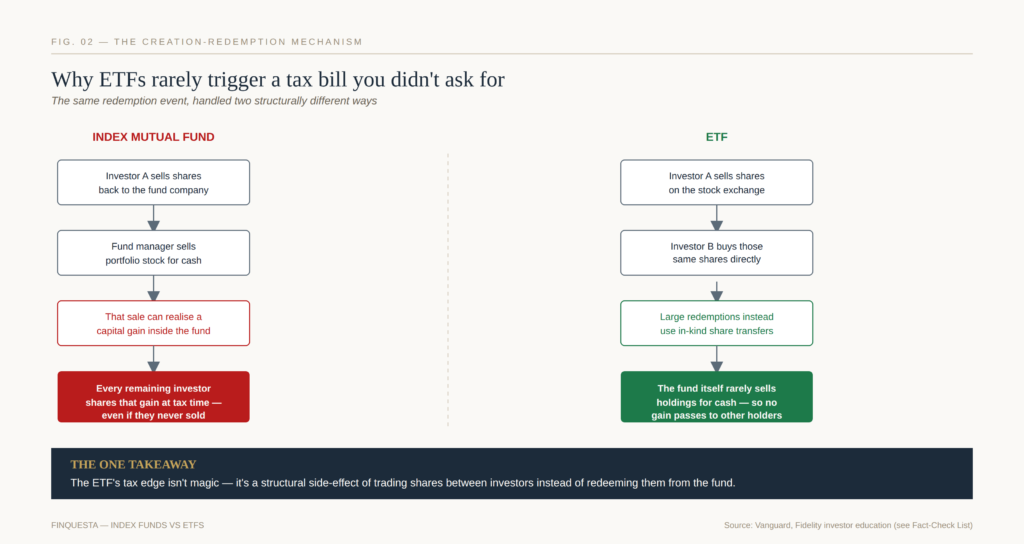
FIG. 02 The same redemption event routed two structurally different ways — cash-based for a mutual fund, in-kind for an ETF.
This tax advantage matters most in a regular taxable brokerage account. Inside a tax-advantaged account — a 401(k), an IRA, or in India an EPF/NPS-linked structure — capital gains distributions don’t create an immediate tax bill either way, so this entire advantage becomes close to irrelevant.
Tax Treatment in the US: What the IRS Actually Sees
This section applies to United States taxpayers. From the IRS’s perspective, ETFs and mutual funds are taxed under the same basic rules: capital gains and dividend income are both taxable, and long-term capital gains — on assets held more than a year — get preferential rates.
The difference isn’t in the tax rate — it’s in how often a taxable event gets triggered involuntarily. As covered above, ETFs generate fewer unplanned capital gains distributions than comparable index mutual funds, which is what people mean when they call ETFs “more tax-efficient.” It’s a difference in frequency of taxation, not in the rate applied once a gain is realized.
None of this matters inside a 401(k), traditional IRA, or Roth IRA — those accounts already shelter or defer the tax on capital gains and dividends, so the ETF tax advantage has nothing to bite into there.
Tax Treatment in India: STCG, LTCG, and a Surprising Non-Difference
This section applies to Indian taxpayers, under the Income Tax Act as amended by the Union Budget 2024, applicable for FY 2025-26 (AY 2026-27). Rules referenced here should be verified against the current Finance Act before publishing, since capital gains rules can change with each year’s Union Budget.
For equity-oriented funds — where at least 65% of the portfolio sits in Indian equities — an index fund and an equity ETF tracking the same benchmark are taxed identically. Units held 12 months or less are taxed as short-term capital gains at 20%, under Section 111A. Units held longer than 12 months qualify for long-term capital gains treatment at 12.5% under Section 112A, and a financial year’s combined equity long-term gains are untaxed up to a ₹1.25 lakh threshold, with only the amount above that taxed.
This is the coverage gap most India-focused comparisons miss: for a plain-vanilla equity index fund versus an equity ETF tracking the same index, the creation-redemption tax advantage that matters so much in the US barely shows up in an Indian investor’s tax bill, because Indian capital gains tax is based purely on the investor’s own holding period and gain — not on whether the fund distributed gains to other holders along the way. The US-style “tax efficiency” argument for ETFs is weaker in the Indian context than most articles suggest.
Where the two do diverge in India is Securities Transaction Tax (STT), a small levy the seller pays on every exchange-listed trade, including ETF units. Paying STT is also the condition that qualifies a trade for the lower Section 111A/112A rates in the first place. Index fund transactions through an AMC don’t carry STT in the same way, though this is a minor cost relative to the STCG/LTCG rate difference itself.
Debt-oriented, gold, silver, and international funds follow a different, more complex set of rules that changed materially after the Finance (No. 2) Act 2024 — those categories deserve their own dedicated comparison rather than a summary here, since the details (holding periods, Section 50AA applicability) are easy to get wrong and change from year to year.
Minimum Investment and Accessibility
Index mutual funds have historically required a minimum initial investment — sometimes as low as zero at large no-minimum providers, sometimes a few thousand rupees or dollars. An ETF’s floor is usually just the price of a single share, and fractional-share investing — now a standard feature at most major brokers — pushes that floor even lower, putting a high-priced ETF within reach of a modest monthly budget.
In practice, this gap has narrowed. Several large fund providers have dropped their index fund minimums to zero, and fractional-share ETF investing is now common at major brokers. The bigger accessibility question today isn’t the minimum check size — it’s whether you already have a brokerage or demat account open, since an ETF strictly requires one and an index fund, in many cases, doesn’t.
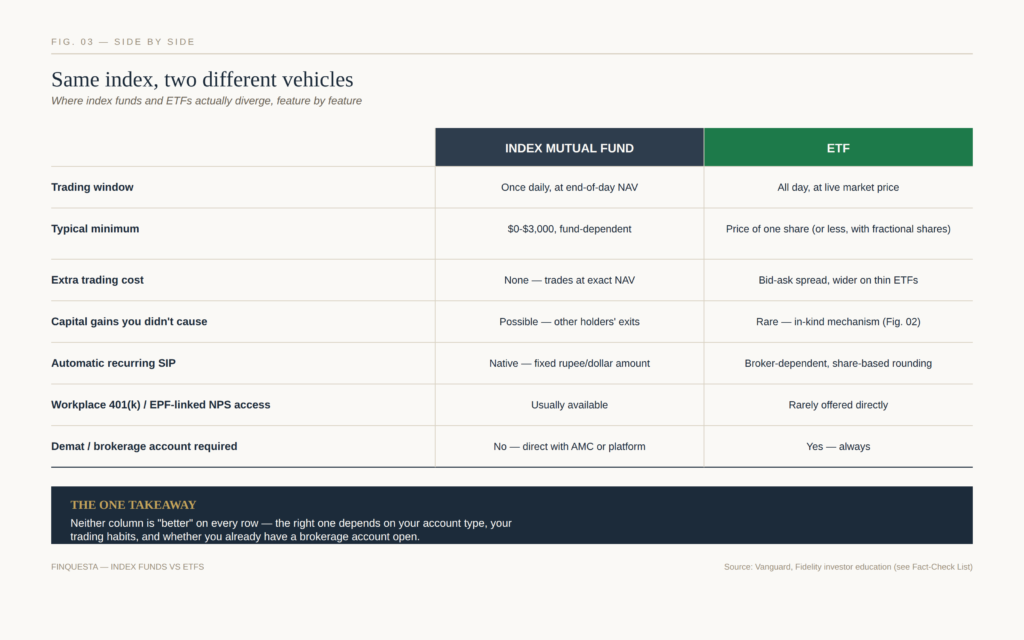
FIG. 03 A feature-by-feature comparison of index mutual funds and ETFs, from trading windows to retirement-account access.
SIP vs Lump Sum: Which Fits Your Habits
A Systematic Investment Plan (SIP) — or, in the US, an automatic recurring investment — lets you invest a fixed sum on a set schedule without manually placing an order each time. Index mutual funds were built for this. You specify a rupee or dollar amount, and the fund company converts it into however many units (including fractional units) that amount buys at the day’s NAV.
ETFs weren’t originally designed around fixed-amount recurring investing, because you buy whole (or, at some brokers, fractional) shares at a live price, not a fixed rupee amount. Some brokers now offer ETF-based SIPs that handle the share-fraction math automatically, but this feature depends entirely on your specific broker or platform — it isn’t universal the way mutual fund SIPs are.
If your plan is “invest the same amount automatically every month and don’t think about it,” the index fund SIP structure removes more friction. If your plan involves occasional, deliberate purchases at moments you choose, the ETF’s live pricing is a better match for that behavior.
Liquidity and the Spread Trap
Here’s a cost that rarely gets quantified in beginner comparisons: the bid-ask spread. When you buy an ETF, you typically pay slightly more than the last traded price; when you sell, you receive slightly less. For a heavily traded ETF tracking the S&P 500 or the Nifty 50, that gap is usually a fraction of a rupee or cent — immaterial. For a niche or thinly traded ETF, the spread can be wide enough that it quietly cancels out the expense-ratio advantage the ETF was supposed to offer.
Original Finquesta concept: we call this the Spread Trap — the tendency for investors to fixate on an ETF’s lower published expense ratio while ignoring the bid-ask spread on a low-volume fund, a cost that never appears in the fact sheet but shows up every single time you trade.
The fix is simple: before buying any ETF, check its average daily trading volume and its typical bid-ask spread (most brokerage platforms display this). If a fund trades thinly, either the expense ratio savings need to be large enough to justify the spread cost, or the index fund version of the same benchmark is probably the more efficient choice.
The Access Lag: The Friction Nobody Names
Every comparison talks about fees and taxes. Almost none talk about the practical friction of actually executing a purchase — and that friction differs meaningfully between the two structures.
Original Finquesta concept: the Access Lag is the gap between deciding to invest and actually completing that investment. An index fund SIP collapses this gap to zero after setup — money moves automatically, at a fixed amount, without you doing anything each month. An ETF purchase requires you to be logged into a live brokerage account during market hours, check a live price, and place a trade — a small but real behavioral hurdle that, repeated monthly for years, is where a meaningful share of “I meant to invest but didn’t get around to it” actually happens.
This isn’t a reason to avoid ETFs — it’s a reason to be honest about which structure matches your actual behavior, not your intended behavior. If automatic, hands-off investing is what keeps you consistent, the index fund’s built-in automation is doing real work that a slightly lower ETF expense ratio can’t make up for.
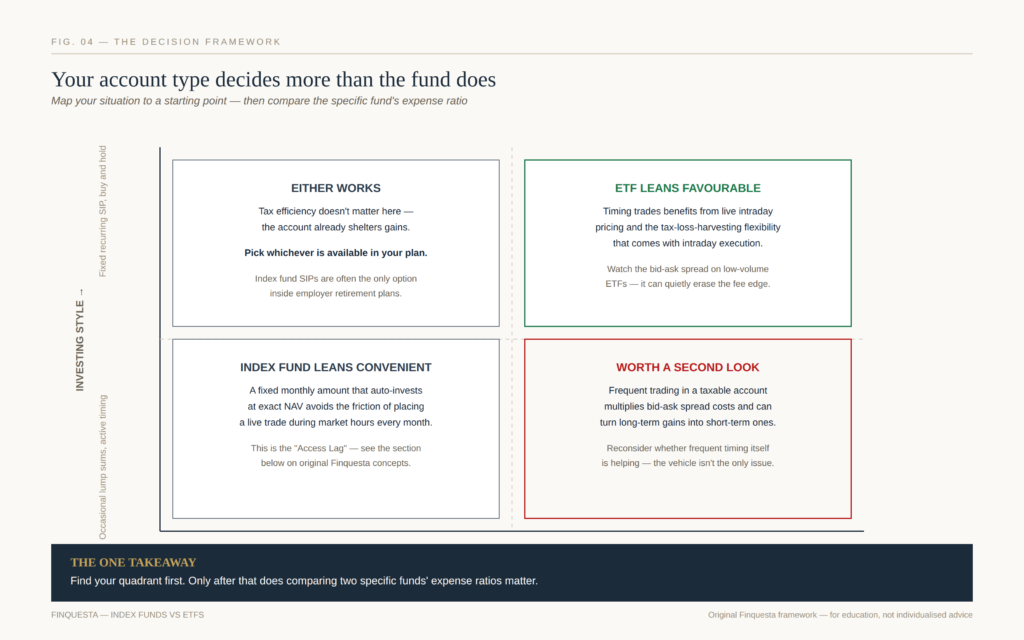
FIG. 04 A simple framework: your account type and investing style narrow the choice before the specific fund’s expense ratio does.
Which Should You Choose? Putting It Together
There’s no universal answer here, and any article that gives you one is skipping the part where your account type and habits matter more than the vehicle. What the evidence above actually supports is a short sequence of questions, in order:
- Is this money going into a tax-advantaged account (401(k), IRA, EPF/NPS-linked structure)? If so, the ETF tax-efficiency argument mostly disappears — pick whichever is available and matches the benchmark you want.
- Do you want a fixed amount to auto-invest every month without logging in? The index fund SIP structure is built for that.
- Are you investing in a regular taxable account and comfortable placing occasional live trades? The ETF’s tax structure and intraday pricing are more likely to work in your favor — provided the specific fund is liquid enough that the bid-ask spread doesn’t erase the benefit.
- Does your workplace retirement plan or platform only offer one of the two? That access constraint usually overrides every other consideration.
This is a framework for evaluating the two structures, not a recommendation of any specific fund, provider, or index — the right choice depends on products, costs, and rules that can change, and that only you (ideally with a licensed advisor) can evaluate for your specific situation.
Common Mistakes Investors Make When Choosing
- Assuming the ETF is automatically cheaper without checking the specific expense ratio of the specific fund.
- Buying a thinly traded ETF and losing the fee advantage to the bid-ask spread (the Spread Trap).
- Treating the US tax-efficiency argument as if it applies the same way to Indian equity funds, when Indian capital gains tax depends on your own holding period rather than on other investors’ redemptions.
- Choosing based on fees or taxes alone, while ignoring whether the Access Lag will realistically derail a recurring investing habit.
- Forgetting that inside a tax-advantaged retirement account, most of the ETF-versus-index-fund tax discussion is moot.
Frequently Asked Questions
What is the difference between an index fund and an ETF in simple terms?
An index fund is a strategy — hold a basket of securities to track a market index. An ETF is a structure — a fund whose shares trade on a stock exchange all day, like a stock. Most ETFs happen to be index funds, but the two words are answering different questions: what the fund owns, versus how you buy and sell it.
Is an ETF safe?
An ETF tracking a broad, well-known index carries the same underlying market risk as an index mutual fund tracking the same benchmark — neither is inherently safer, since they can hold nearly identical portfolios. The structure itself (exchange-traded shares, regulated by the SEC in the US or SEBI in India) is not a source of additional risk for a standard, broad-market index ETF.
Can I lose money in an index fund or ETF?
Yes. Both track a market index, and if that index falls, the fund’s value falls with it. Neither structure protects you from market-wide declines — that protection doesn’t come from choosing index fund versus ETF, it comes from your asset allocation and time horizon.
What is the difference between an index fund and an ETF for tax purposes?
In the US, ETFs typically distribute capital gains to shareholders less often than comparable index mutual funds — a byproduct of the in-kind share-transfer process described above, rather than anything about the tax rate itself. In India, for equity-oriented funds, the two are taxed almost identically under Sections 111A and 112A, since Indian capital gains tax depends on your own holding period rather than on fund-level redemption activity.
Index fund vs ETF — which is better for a beginner?
For a beginner setting up automatic monthly contributions with no interest in watching live prices, the index fund SIP structure typically removes more friction. For a beginner who already has a brokerage account and wants the flexibility of intraday pricing, a liquid, broad-market ETF is an equally reasonable starting point. Neither is objectively “better” — see the Decision Framework above.
How many index funds or ETFs should I own?
There’s no fixed number that applies to everyone, and this is a portfolio construction question rather than an index-fund-versus-ETF question. Many long-term investors build a portfolio around a small number of broad, low-cost, non-overlapping index funds or ETFs rather than accumulating many overlapping ones — but the right number depends on your goals, risk tolerance, and account structure.
Do ETFs have a minimum investment?
Generally no minimum beyond what one share costs, and fractional-share investing at most major brokers pushes that floor lower still. Index mutual funds vary by provider — some have dropped their minimums to zero, others still require an initial minimum investment ranging from a small amount to several thousand rupees or dollars.
What is the difference between an index fund and an actively managed fund?
This is a different comparison than index fund vs ETF. An index fund (whether structured as a mutual fund or an ETF) tries to match a benchmark as closely as possible at low cost. An actively managed fund has a manager making buy/sell decisions attempting to beat a benchmark, typically at a higher expense ratio. Both index mutual funds and index ETFs are, by definition, passive; the active-vs-passive question is a separate axis from the mutual-fund-vs-ETF question covered in this article.
Disclaimer
This article is for informational and educational purposes only and does not constitute financial, investment, tax, or legal advice. Figures, rates, and regulations mentioned are subject to change; please verify current details with official sources (RBI, SEBI, the Income Tax Department, IRS, or a licensed financial advisor) before making financial decisions. Finquesta may earn a commission from affiliate links in this article at no extra cost to you.
1 thought on “Index Funds vs ETFs: Pick the Best Fit in 2026”