
Every March, millions of salaried Indians rush to top up PPF, buy an ELSS fund, or push a little extra into NPS before the financial year closes. For a growing share of them — anyone who has already moved to the default new tax regime — that entire ritual now saves exactly nothing, because Section 80C simply doesn’t apply to their return anymore.
| PPF (Public Provident Fund), ELSS (Equity Linked Savings Scheme) and NPS (National Pension System) are India’s best-known tax-saving investments, each linked to what was Section 80C — now Section 123 under the Income-tax Act, 2025. PPF pays a fixed, quarterly-declared rate over 15 years. ELSS is an equity mutual fund with a mandatory 3-year lock-in, the shortest Section 123 option. NPS is a market-linked retirement account, regulated by the PFRDA and locked in until 60, offering an extra ₹50,000 deduction none of the others get. |
Why “PPF vs ELSS vs NPS” Only Matters If You’re Still on the Old Tax Regime
Before comparing lock-ins or returns, ask a more basic question: does any of this apply to you at all? The new tax regime has been the default since FY 2023-24. Under the Union Budget 2025 reforms — carried forward unchanged into Budget 2026 — a resident individual owes zero tax on taxable income up to ₹12 lakh.
For a salaried filer, the ₹75,000 standard deduction effectively pushes the tax-free line to roughly ₹12.75 lakh of salary. HRA, Section 123 (old 80C), 80D-type deductions, and the NPS employee-contribution deductions are all disallowed under the new regime, which is exactly what makes that threshold matter here.
If your salary sits under roughly ₹12.75 lakh, the government has already zeroed out your tax bill without you lifting a finger. Investing in PPF, ELSS, or NPS for a “tax benefit” that doesn’t exist for you is solving a problem you don’t have — the money would do more for you sitting in whichever of the three actually fits your goals, tax deduction or not.
Above that income level, or if your deductions — home loan interest, HRA, Section 123, medical insurance — are large enough to beat the new regime’s lower slabs on their own, the old regime becomes worth actively choosing (via Form 10-IEA for those without business income), and this entire comparison starts to matter again. That’s who the rest of this guide is written for.
What Is PPF (Public Provident Fund)?
Meera opened her PPF account the year she got her first job offer letter, mostly because her father told her to. Fifteen years is a strange number to commit to at 23, but that’s exactly the point — PPF rewards the version of you that doesn’t touch it.
PPF is a savings scheme run through post offices and most major banks, backed by a sovereign guarantee, currently paying 7.1% per annum for the July–September 2026 quarter. The Finance Ministry has held this rate unchanged since April 2020, most recently confirmed in its June 30, 2026 notification on small savings schemes; it’s reviewed every quarter and can change, though it’s been remarkably stable for over six years.
You can invest between ₹500 and ₹1.5 lakh in a financial year, and interest compounds annually on the lowest monthly balance. The account matures 15 years after opening, not from your first deposit, and at maturity you can either withdraw the full amount, or extend it in blocks of five years — with or without making further contributions during the extension.
A loan against the balance is available from the third year through the sixth year. Partial withdrawal opens up from the seventh financial year onward, capped at the lower of 50% of the balance at the end of the fourth preceding year or the immediately preceding year. Both the interest and the maturity amount are entirely tax-free, regardless of which tax regime you file under.
What Is ELSS (Equity Linked Savings Scheme)?
Rohan did the opposite of Meera. He picked ELSS specifically because he didn’t trust himself to stay invested for 15 years, and three felt survivable.
ELSS is an open-ended equity mutual fund — meaning it invests at least 80% of its portfolio in stocks — that carries a mandatory 3-year lock-in, the shortest of any Section 123 (formerly 80C) instrument. You can invest via SIP or lump sum, and there’s no upper cap on how much you can put into ELSS itself, though only ₹1.5 lakh of it counts toward your deduction in a given year.
Like any equity mutual fund, ELSS is available as a direct plan (bought straight from the fund house, lower expense ratio) or a regular plan (bought through a distributor, with a trail commission built into the cost). The lock-in, tax treatment, and underlying stocks are identical either way — only the expense ratio and whether you get advice alongside the investment differ, which is worth knowing before you assume the two are interchangeable.
Because it’s equity, returns aren’t fixed or promised — they track whatever the fund’s underlying stocks do, for better and for worse. Once the 3-year lock-in ends, gains are taxed as long-term capital gains at 12.5% on anything above ₹1.25 lakh in a financial year, a rate applied the same way regardless of which tax regime you file under, since capital gains taxation sits outside the Section 123/regime framework entirely.
What Is NPS (National Pension System)?
NPS is the odd one out in this comparison, because it isn’t really a tax-saving product that happens to fund retirement — it’s a retirement product that happens to save tax along the way. Regulated by the Pension Fund Regulatory and Development Authority (PFRDA), it invests your contributions across equity (E), corporate bonds (C), and government securities (G), in a mix you choose yourself (active choice) or that shifts automatically toward safety as you age (auto choice).
Since inception, government-sector NPS has delivered an average CAGR of about 9.5%, while non-government-sector asset classes have returned roughly 14% for equity, 9.1% for corporate debt, and 8.8% for government securities, according to Finance Minister Nirmala Sitharaman’s remarks at the September 2024 launch of NPS Vatsalya. Treat these as a long-run reference point, not a promise — markets and fund manager performance both move around a lot year to year.
Your own contribution to a Tier I account is locked in until age 60, with limited exceptions. NPS is also the only one of the three that carries an extra deduction — up to ₹50,000 under what was Section 80CCD(1B), independent of the ₹1.5 lakh Section 123 ceiling — which is the single biggest reason people include it in this comparison at all.
Under auto choice, NPS uses lifecycle funds that start you at a higher equity allocation in your twenties and thirties, then taper equity down and shift toward government securities as you approach 60 — a glide path similar in spirit to a target-date fund, just built specifically around the retirement age NPS assumes for you. Active choice hands you the steering wheel directly, letting you set and rebalance your own E/C/G split, within PFRDA-set limits on how much can sit in equity at any age.
Tier I vs Tier II — The NPS Distinction Most Comparisons Skip
Most comparisons like this one talk about “NPS” as if it’s a single account, and quietly gloss over the fact that it’s actually two. Tier I is the pension account — the one that carries every tax benefit discussed in this guide, and the one locked in until 60. Tier II is a voluntary add-on savings account with no lock-in at all; you can withdraw from it any working day, like a mutual fund folio.
The catch is that Tier II carries no tax deduction for most subscribers — you don’t get a Section 123 or Section 124 benefit for money parked there, with a narrow exception for certain government employees under a separate scheme. For everyone else, Tier II functions as a flexible, market-linked savings account that happens to sit inside the NPS ecosystem, not a tax-saving vehicle in its own right.
This matters for the comparison because every NPS figure elsewhere in this guide — the lock-in until 60, the ₹50,000 deduction, the 80%/60% withdrawal question — refers specifically to Tier I. If you ever see NPS Tier II pitched to you as a tax-saving option the way PPF or ELSS is, that’s worth double-checking against the current rules before you assume it works the same way.
PPF vs ELSS vs NPS: Lock-In and Liquidity Compared
Lock-in is where these three instruments stop looking like three flavors of the same thing and start looking like genuinely different financial products. ELSS lets go of you after three years. PPF holds on for fifteen, with a partial-withdrawal escape hatch from year seven. NPS Tier I doesn’t really let go until you turn 60, full stop.
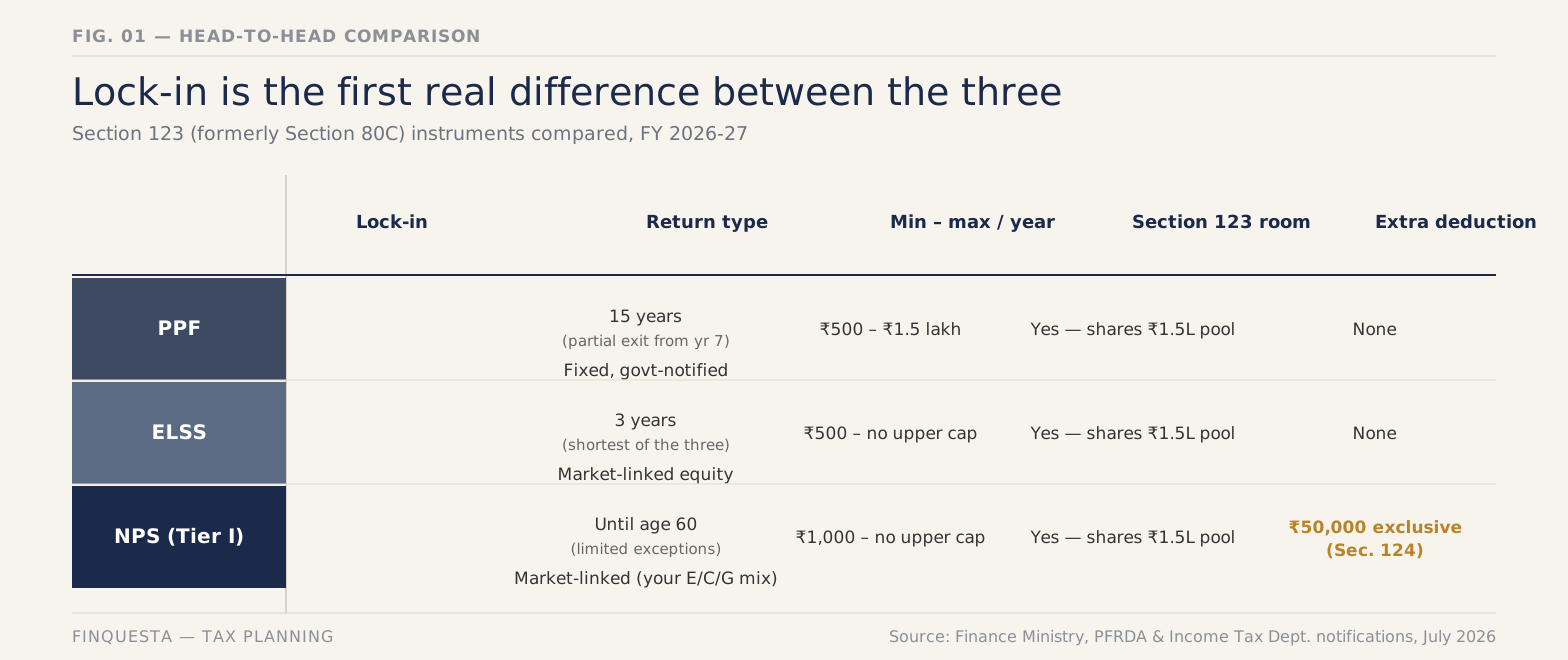
That gap is the first filter worth applying to your own decision, well before you get to returns or risk: if there’s a real chance you’ll need this money in the next five years, NPS is disqualified before the conversation even starts, and PPF only clears the bar if year seven onward lines up with your plans. For a deeper look at how fund structure affects access to your money, explains how open-ended mutual funds like ELSS differ from other pooled investments more broadly.
How the New Income Tax Act, 2025 Renames (But Doesn’t Remove) These Deductions
Here’s something most PPF vs ELSS vs NPS comparisons published before mid-2026 won’t tell you, simply because it hadn’t happened yet when they were written: the Income-tax Act, 1961 has been replaced. The Income-tax Act, 2025 took effect on April 1, 2026, and governs Tax Year 2026-27 onward — the year most readers of this guide are currently investing for.
Under the new Act, familiar section numbers have been reorganised into a single sequential system. Section 80C — the ₹1.5 lakh umbrella that PPF and ELSS both sit under — is now Section 123, read with Schedule XV. The NPS-specific deductions that used to live under Section 80CCD are now grouped under Section 124.
None of the deduction amounts changed, and none of the eligible instruments changed — this is a renumbering exercise, not a policy shift. One practical wrinkle is worth flagging anyway: if you’re filing your return for FY 2025-26 in July 2026, you’re still using the old 1961 Act’s section numbers on that form. The new numbers only apply starting with returns for FY 2026-27, filed in 2027 — the kind of gap that trips people up precisely because both systems are technically “current” at once, for different tax years.
How Much Tax Each Instrument Actually Saves You
The honest way to think about the tax benefit here isn’t “PPF vs ELSS vs NPS” — it’s two separate buckets that happen to share a wall.
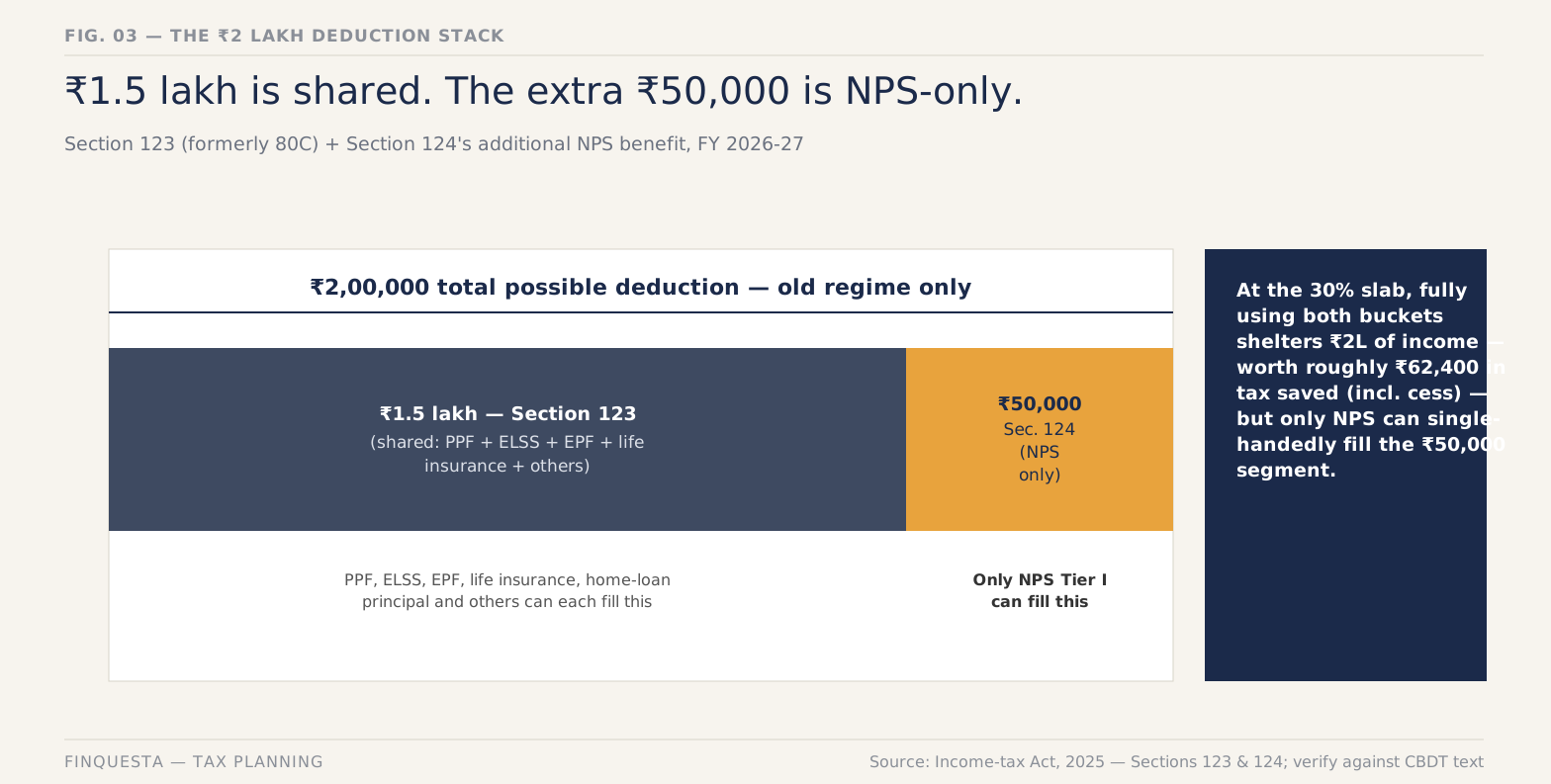
Bucket one is Section 123 (old 80C), capped at ₹1.5 lakh combined across PPF, ELSS, life insurance premiums, EPF, and a handful of other instruments. Put ₹1.5 lakh into PPF alone, and there’s nothing left for ELSS to add here, even if you invest more in it. Bucket two is the NPS-exclusive ₹50,000 under Section 124’s additional-deduction clause, which doesn’t touch bucket one at all — max out both, and you’ve sheltered ₹2 lakh of income, but only NPS can single-handedly fill bucket two.
For someone in the 30% slab (plus 4% cess), that ₹50,000 NPS-only deduction is worth roughly ₹15,600 in tax saved every year it’s used, at zero extra cost beyond accepting the lock-in. That’s precisely why planners tend to describe it as one of the highest-leverage single moves available under the old regime, even for people who’ve already maxed out their ₹1.5 lakh elsewhere.
There’s a fourth instrument already quietly eating into that same ₹1.5 lakh bucket for most salaried readers, and most comparisons like this one never mention it: EPF (Employee Provident Fund). Your mandatory 12% employee contribution to EPF also falls under Section 123, alongside PPF and ELSS, not in some separate allowance.
For a salaried employee already contributing a meaningful EPF amount every month, the real question usually isn’t “how do I split ₹1.5 lakh across PPF, ELSS and NPS” — it’s “how much of that ₹1.5 lakh does EPF leave for the other two.” Someone with ₹1.2 lakh of annual EPF contribution has only ₹30,000 of Section 123 room left, regardless of how much they’d like to put into PPF or ELSS.
This is worth checking on your payslip or Form 16 before you plan a PPF or ELSS contribution around the full ₹1.5 lakh figure — a number this guide, and most others, uses as a clean round ceiling that assumes you’re starting from zero.
Returns — One Fixed, One Market-Linked, One In Between
PPF’s return isn’t really a forecast — it’s whatever the government notifies each quarter, currently 7.1%, and it moves slowly by design. ELSS has no floor and no ceiling; a strong three-year window can outrun both PPF and NPS by a wide margin, and a weak one can leave you at breakeven or worse. NPS sits between the two by construction — you choose how much of your money sits in equity, corporate debt, and government securities, so its return profile is really a dial you control, not a fixed number.
Resist the urge to rank these three by a single trailing-return number pulled from any one year. A three-year window that happens to end in a market peak makes ELSS look unbeatable, and one that ends in a correction makes it look reckless — neither is the full story. The honest comparison isn’t “which had the best return last year,” it’s “which return profile matches how much volatility you can actually sit through without pulling out at the wrong time.”
Risk — What You’re Actually Signing Up For
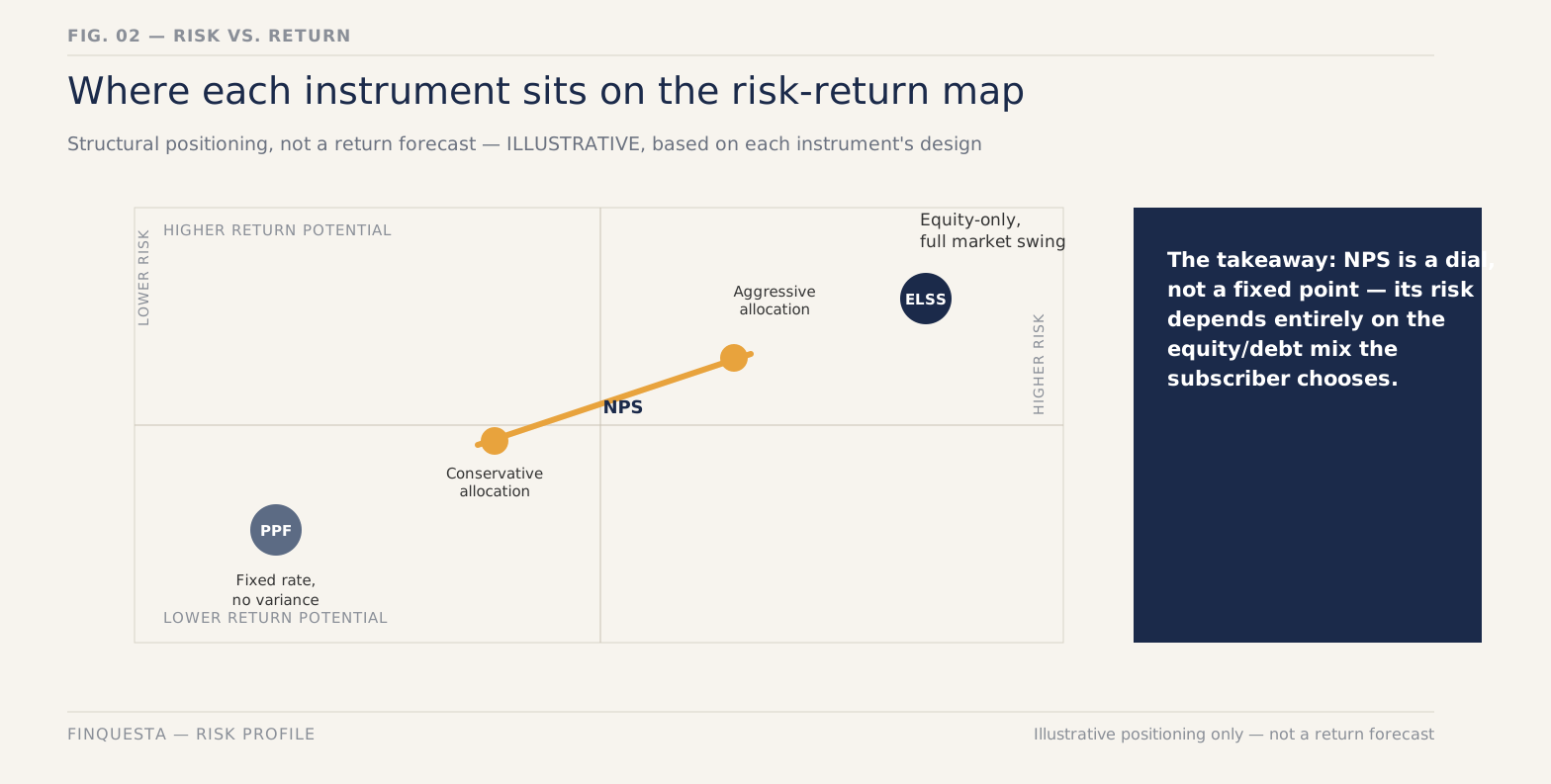
PPF’s risk isn’t market risk — it’s the risk that 7.1% quietly loses to inflation over 15 years, since the rate is fixed by notification, not by markets. Nothing about a PPF passbook ever looks alarming, which is exactly why this risk is the easiest of the three to miss.
ELSS carries real, visible volatility: it can be down 15% the year after you invest, which is exactly why the 3-year lock-in exists. It’s a guardrail against panic-selling into a dip, not just a tax rule bolted on for no reason.
NPS’s risk depends entirely on the equity/debt mix you pick. An aggressive allocation behaves like ELSS with extra bureaucracy, and a conservative one behaves closer to PPF, but with market exposure standing in for a fixed rate — meaning “how risky is NPS” doesn’t have one answer until you know which allocation a subscriber actually chose.
The Regime Survivors Test — An Original Finquesta Framework
Most comparisons treat PPF, ELSS, and NPS as three peers standing side by side. They stop being peers the moment you ask a sharper question: if you switched to the new tax regime tomorrow, which part of each instrument’s benefit would actually survive?
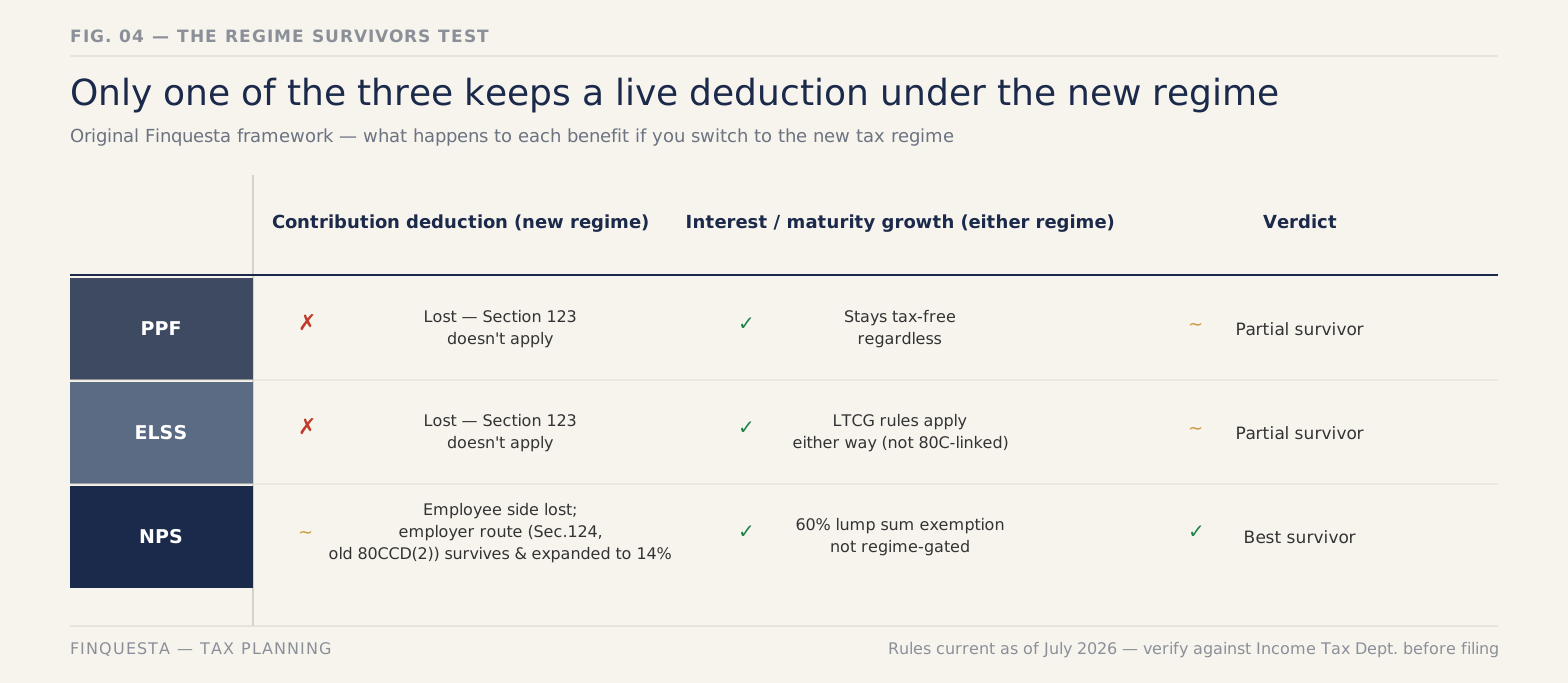
Run PPF through the test and the contribution deduction dies instantly — Section 123 doesn’t exist for new-regime filers. But the interest and maturity amount stay tax-free regardless, because that exemption lives under a separate provision that was never regime-gated in the first place. Most people conflate “losing the 80C benefit” with “PPF becomes taxable,” and that’s simply wrong — only the deduction on the way in disappears.
Run ELSS through the same test and the deduction dies the same way, but ELSS loses something PPF doesn’t. Without the tax benefit, there’s no longer any reason to accept a 3-year lock-in over an identical-strategy equity fund with no lock-in at all — under the new regime, “ELSS” as a distinct product effectively stops making sense, even though the underlying fund keeps running fine.
NPS is the only one that comes out ahead. Its employee-side deductions — Section 124’s equivalent of 80CCD(1) and the ₹50,000 top-up — die under the new regime exactly like the others’ do.
But the employer contribution route, under what was Section 80CCD(2), not only survives the new regime, it was expanded: the deductible cap rose to 14% of salary for all employers from FY 2025-26, up from 10% for private-sector staff. If your employer offers NPS through a flexible-benefits structure, that’s a live tax lever whether or not you file Form 10-IEA to opt into the old regime.
The Exemption Gap — NPS’s New 80% Withdrawal Rule vs. Its 60% Tax-Free Ceiling
In December 2025, the PFRDA overhauled NPS exit rules. Non-government subscribers can now withdraw up to 80% of their corpus as a lump sum at retirement, up from 60%, with the mandatory annuity portion falling to a minimum of 20%. Government-sector subscribers stay on the older 60%/40% split. Call the mismatch this creates the Exemption Gap — an original Finquesta framework for a problem that doesn’t have an official name yet.
Here’s the catch almost no one has caught up on yet: the tax exemption under what was Section 10(12A) — the provision that makes your NPS lump sum tax-free — was written around the old 60% ceiling and hasn’t been amended to match. The newly-permitted extra 20%, the slice between 60% and 80%, is therefore taxable at your slab rate rather than automatically tax-free, as things currently stand.
Practically, this means the headline “you can now take out 80%!” is true and slightly misleading at the same time. You can, but doing so without a plan could hand back in tax a chunk of what the new rule just gave you. Anyone retiring in the next few years should model both the 60% and 80% withdrawal scenarios before deciding, rather than assuming more lump sum is automatically the better outcome.
ELSS SIP vs Lump Sum — Does the Lock-In Reset Every Month?
Yes, and this catches people off guard. A lump sum investment locks in for three years from that one date. A SIP is different — each monthly instalment is treated as its own separate investment, so your January instalment unlocks in three years, February’s unlocks a month after that, and so on, all the way through the SIP.
This isn’t a flaw; it’s just how a rolling investment works. In practice it means an ongoing ELSS SIP never fully “unlocks” while you keep contributing, since there’s always a slice still inside its own three-year window. That’s worth knowing before you assume you can redeem the entire pot the moment your very first instalment crosses the three-year mark.
PPF vs ELSS vs NPS for the Self-Employed
Salaried employees get one extra lever the self-employed don’t: the employer NPS route under Section 124 (old 80CCD(2)), which survives in both tax regimes. Without an employer, that lever simply isn’t available, which quietly shifts the self-employed comparison of PPF vs ELSS vs NPS toward the old regime mattering more, not less, since it’s the only place any of the three still offers a deduction.
For self-employed investors, NPS’s own-contribution deduction under Section 124 is capped at 20% of gross total income, versus 10% of salary for the salaried — which can work out to a meaningfully larger number for a high-earning freelancer or business owner than the salaried version of the same rule. PPF and ELSS work identically regardless of employment status, since both are personal accounts with no employer link at all.
Income variability is the other practical factor worth weighing here. PPF’s ₹500 minimum and flexible deposit schedule within the year suit a freelancer’s uneven cash flow better than a fixed monthly SIP commitment might, in a slow month. Neither NPS nor ELSS requires a fixed contribution either, but a lapsed PPF deposit in a given year only needs a small penalty to reactivate, which is a gentler failure mode than letting an NPS account go inactive.
Can You Use All Three Together? A Practical Way to Split ₹2 Lakh
Most people don’t need to pick a single winner — they need a way to fill ₹2 lakh across two buckets without overthinking it. Start with the ₹50,000 NPS-only deduction, since nothing else can fill it, then split the remaining ₹1.5 lakh across PPF and ELSS based on how much volatility you can tolerate and how soon you might need the money.
Someone five-plus years from any major goal, with a stable income and a stomach for equity swings, might lean harder into ELSS for the growth and use PPF as the boring, guaranteed anchor for the rest of the ₹1.5 lakh. Someone closer to a goal, or who knows they’d panic-sell in a downturn, is often better served doing more of that ₹1.5 lakh through PPF and treating ELSS as a smaller, deliberate bet on the side.
Neither answer is wrong — the split should track your own tolerance for watching the number go down, not a generic rule of thumb copied from a friend’s portfolio. walks through a broader framework for matching investment types to specific goals, which extends the same logic beyond just these two instruments.
How Often Do These Rules Change? (And Why That Matters for Your Plan)
If this article feels unusually preoccupied with dates and version numbers, that’s deliberate. In the twelve months before this guide was published, PPF’s rate was reconfirmed quarterly, the entire Income Tax Act was replaced and renumbered, NPS’s withdrawal rules were overhauled by the PFRDA, and the new regime’s rebate threshold was reset by the Union Budget. None of that is unusual — it’s the normal pace of change for these three instruments.
The practical takeaway isn’t to distrust any comparison like this one; it’s to treat the numbers as time-stamped and the mechanics as durable. PPF being a fixed-rate government scheme, ELSS having a 3-year lock-in, and NPS being locked till 60 are structural facts unlikely to change soon. The exact rate, the exact deduction limit, and the exact withdrawal split are exactly the kind of details worth re-checking against an official source before you act on them, even if you read this guide the week it was published.
Common Mistakes Investors Make Between PPF, ELSS and NPS
The single most common one: investing in all three under the new tax regime, for a deduction that no longer exists on the contribution side, purely out of habit from years past. Check your regime before your March tax-saving rush, not after.
A second mistake is treating PPF’s 7.1% as risk-free in every sense. It’s default-risk-free, not inflation-risk-free, and 15 years of a rate that barely beats inflation can quietly underperform a well-chosen ELSS fund by a wide margin, even after accounting for ELSS’s volatility.
A third is assuming NPS’s newly-permitted 80% lump sum is automatically better than 60%. As covered above, the extra 20% currently carries a tax bill the older 60% withdrawal never did, and skipping that math before retirement is an easy way to give back real money.
A fourth, quieter mistake is picking ELSS purely because “it’s the shortest lock-in,” without checking whether a three-year horizon actually suits the goal the money is meant for. A short lock-in that ends in a down market is still a down market — the calendar doesn’t protect you from timing risk the way it protects you from your own impatience.
A fifth is planning a PPF or ELSS contribution around the full ₹1.5 lakh ceiling without first checking how much of it mandatory EPF has already used. It’s an easy number to overlook, since it never shows up as a deliberate “investment decision” the way choosing a fund or opening an account does.
PPF vs ELSS vs NPS: Which One Actually Wins?
There isn’t a single winner, and any comparison of PPF vs ELSS vs NPS that hands you one number as “the answer” is oversimplifying a decision that genuinely depends on your regime, your time horizon, and your tolerance for watching a balance move.
| QUICK VERDICT, BY PRIORITY If your single priority is the tax break itself and nothing else, NPS wins — it’s the only instrument with a deduction bucket none of the others can touch. If your priority is capital safety with zero decision-making required, PPF wins, since nothing here is safer or simpler. If your priority is liquidity and growth potential, ELSS wins, by a wide margin, on both counts. |
Most people who’ve actually worked through their own regime, horizon, and risk tolerance end up using two of the three, or all three, rather than picking one and walking away. covers how to think about tax-saving investments as part of a wider financial plan, if you’re building that fuller picture from scratch.
Whichever combination you land on, the practical next step is the same: check your current-year Section 123 room against any EPF already deducted, confirm your regime choice for the year, and only then decide how much goes where — in that order, not the reverse.
How to Actually Open Each Account
Opening any of the three is simpler than the tax rules around them suggest. A PPF account can be opened online through most major banks’ net-banking portals, or in person at a post office or bank branch, with basic KYC — PAN, address proof, and a passport-style photo. Most banks let you fund it the same day through net banking, with no separate demat account required.
ELSS works exactly like any other mutual fund purchase: through the fund house’s own website or app, a registered mutual fund distributor, or an aggregator platform, using PAN and a completed KYC check that most investors already have on file from an earlier fund purchase. No demat account is required to hold ELSS units, though one can be used if you prefer.
NPS requires opening an account through the eNPS portal, a bank, or a registered Point of Presence, which issues a Permanent Retirement Account Number (PRAN) — the identifier that follows you across employers and fund manager changes for as long as the account stays open. Choosing a fund manager and an E/C/G allocation (or auto choice) happens at this stage, and both can be changed later within PFRDA’s permitted limits.
Frequently Asked Questions
What is PPF, ELSS, and NPS in simple terms?
PPF is a government savings account with a fixed interest rate and a 15-year term. ELSS is an equity mutual fund with a 3-year lock-in that qualifies for a tax deduction. NPS is a market-linked retirement account locked in until age 60, with an extra deduction no other instrument offers.
Is NPS safe?
NPS is regulated by the PFRDA and invested through licensed pension fund managers, so it carries low regulatory and default risk — there’s no equivalent of a bank run or an AMC shutting down and taking your money with it. Its returns are market-linked, though, meaning your corpus can fall in value in a bad year, especially with a higher equity allocation. Safety here means “well-governed,” not “guaranteed,” which is a different promise than PPF makes.
Can I lose money in ELSS?
Yes. ELSS invests primarily in equities, so its value moves with the stock market, and a three-year window can end lower than it started, especially if that window includes a sharp downturn. The 3-year lock-in doesn’t protect your capital — it only prevents you from selling in a panic before the window closes.
What is the difference between PPF and NPS?
PPF pays a fixed, government-notified interest rate and matures in 15 years, with earlier partial-withdrawal options from year seven. NPS is market-linked, locked in until age 60, and offers an extra ₹50,000 deduction that PPF doesn’t. PPF’s growth is entirely tax-free regardless of regime; NPS’s own-contribution deduction is old-regime-only.
ELSS vs PPF — which is better for tax saving?
Both sit under the same ₹1.5 lakh Section 123 ceiling, so neither gives you more deduction than the other rupee-for-rupee — the difference is what happens to your money after the deduction. ELSS offers a shorter lock-in and higher growth potential with real volatility; PPF offers a fixed, guaranteed return with a much longer commitment.
How many years can I stay invested in NPS?
Your Tier I account stays open until age 60 at minimum. Under current PFRDA rules, you can choose to remain invested and defer withdrawal up to age 75, continuing to benefit from compounding and market exposure throughout that extended window.
Can I invest in PPF, ELSS and NPS in the same year?
Yes, and many people do — there’s no rule against holding all three simultaneously. Just remember that PPF and ELSS draw from the same ₹1.5 lakh Section 123 pool, so investing the full amount in one leaves nothing for the other within that specific ceiling. NPS’s extra ₹50,000 is separate from both and doesn’t share that limit.
What happens to my ELSS and PPF if I switch to the new tax regime?
You stop getting the Section 123 deduction on new contributions going forward, but existing PPF and ELSS holdings aren’t affected retroactively. Your PPF interest stays tax-free, and ELSS units already bought keep their original lock-in and capital-gains treatment. The regime choice only changes what you can newly deduct, not what you already hold.
Which is better for retirement — NPS or PPF?
NPS is purpose-built for retirement, with a lock-in that matches that goal and market-linked growth that has historically outpaced PPF over long periods, though with real year-to-year volatility along the way. It also passes the Regime Survivors Test better than PPF does, thanks to the employer-contribution route. PPF can supplement retirement savings but was never designed as a standalone retirement product, since its 15-year term is shorter than most people’s working life.
Can NRIs invest in PPF, ELSS, or NPS?
NRIs cannot open a new PPF account, though an account opened while resident can run to maturity under specific conditions. NRIs can invest in ELSS through NRE or NRO accounts, subject to fund-house terms, and can open an NPS account as well, though certain withdrawal and repatriation rules differ from those for resident Indians.