
For the first time in 60 years, Warren Buffett did not write Berkshire Hathaway’s annual letter to shareholders. He handed that pen to Greg Abel at the start of 2026, telling shareholders in his final Thanksgiving letter that he was “going quiet.” That single fact turns Buffett’s shareholder letters from a running series into something closed and complete.
Warren Buffett’s shareholder letters are the annual messages he wrote to Berkshire Hathaway’s shareholders from 1965 through 2024, plus one final personal note in November 2025. They report Berkshire’s results, but they’re read for something else: a plain-language education in business, risk, and investor behavior, free of the PR polish most corporate filings carry. Anyone can read the full archive on Berkshire’s own website at no cost. Greg Abel writes Berkshire’s letter now — but the 60-year Buffett archive is what most people still mean by “Buffett’s letter.”
Table of Contents
Wall Street reads Warren Buffett’s shareholder letters for the numbers. Everyone else reads them for the fourth paragraph, where Buffett usually says the thing nobody else in finance is willing to say plainly. This guide pulls together the lessons from those shareholder letters that actually hold up — not as a highlight reel of quotes, but as ideas you can apply the next time you’re deciding what to buy, what to sell, or whether to panic.
What Are Warren Buffett’s Shareholder Letters?
Every February from 1965 to 2025, a letter signed by Warren Buffett appeared at the front of Berkshire Hathaway’s annual report. It reported the year’s results, but it did something unusual for a corporate filing: it explained the reasoning behind the results, in Buffett’s own words, without a communications team softening the language.
Buffett treated shareholders as business partners rather than an audience to be managed. He wrote about Berkshire’s failures with the same directness as its successes, named his own mistakes by name, and explained financial concepts — float, intrinsic value, owner earnings — in language a first-time investor could follow. That combination is why professional money managers and total beginners have read the same eleven pages every spring for six decades.
The letters are archived and free to read on Berkshire Hathaway’s own website, going back to 1977 in original form. Nothing about accessing them costs money, and nothing in them requires a finance degree to follow.
Why Warren Buffett’s Shareholder Letters Just Became a Complete, Closed Chapter
Context matters here, because it changes what kind of article this actually is. This isn’t a summary of one year’s letter — it’s a look back at the finished set, and the reason the set is finished just happened.
On November 10, 2025, Buffett sent what he called his Thanksgiving letter — a personal note to shareholders and his children, distinct from the formal annual report. In it, he confirmed he would step down as CEO at year-end, handing the role to Greg Abel. He said he would no longer write Berkshire’s annual report or speak at length at the shareholder meeting. He’d keep sending the Thanksgiving letter, he wrote, but the tradition he started in 1965 — one CEO, one voice, one letter a year explaining the business — was over.
Abel became CEO on January 1, 2026. His first annual letter to shareholders, covering Berkshire’s 2025 results, was dated February 28, 2026. He opened it by calling Buffett “arguably the greatest investor of all time,” and used much of the letter to write down Berkshire’s culture and capital-allocation principles explicitly for the first time — something Buffett had mostly conveyed through decades of accumulated example rather than a single stated list.
None of this makes Buffett’s own letters less useful. If anything, it’s the opposite. A 60-year body of work you can read start to finish, from a 34-year-old buying a failing textile mill to a 95-year-old handing the keys to his chosen successor, is a more complete education than any single year’s letter could be. A good starting discipline, before you read a single lesson below: pull up how to actually evaluate a company’s numbers yourself, so the lessons have something concrete to attach to.
Berkshire’s 60-Year Scorecard: What the Numbers Actually Show
Buffett included one table in nearly every letter he wrote: Berkshire’s per-share market value against the S&P 500, year by year, going back to 1965. It’s one of the most audited scorecards in investing, because Buffett published the misses right alongside the wins, every single year, without exception.
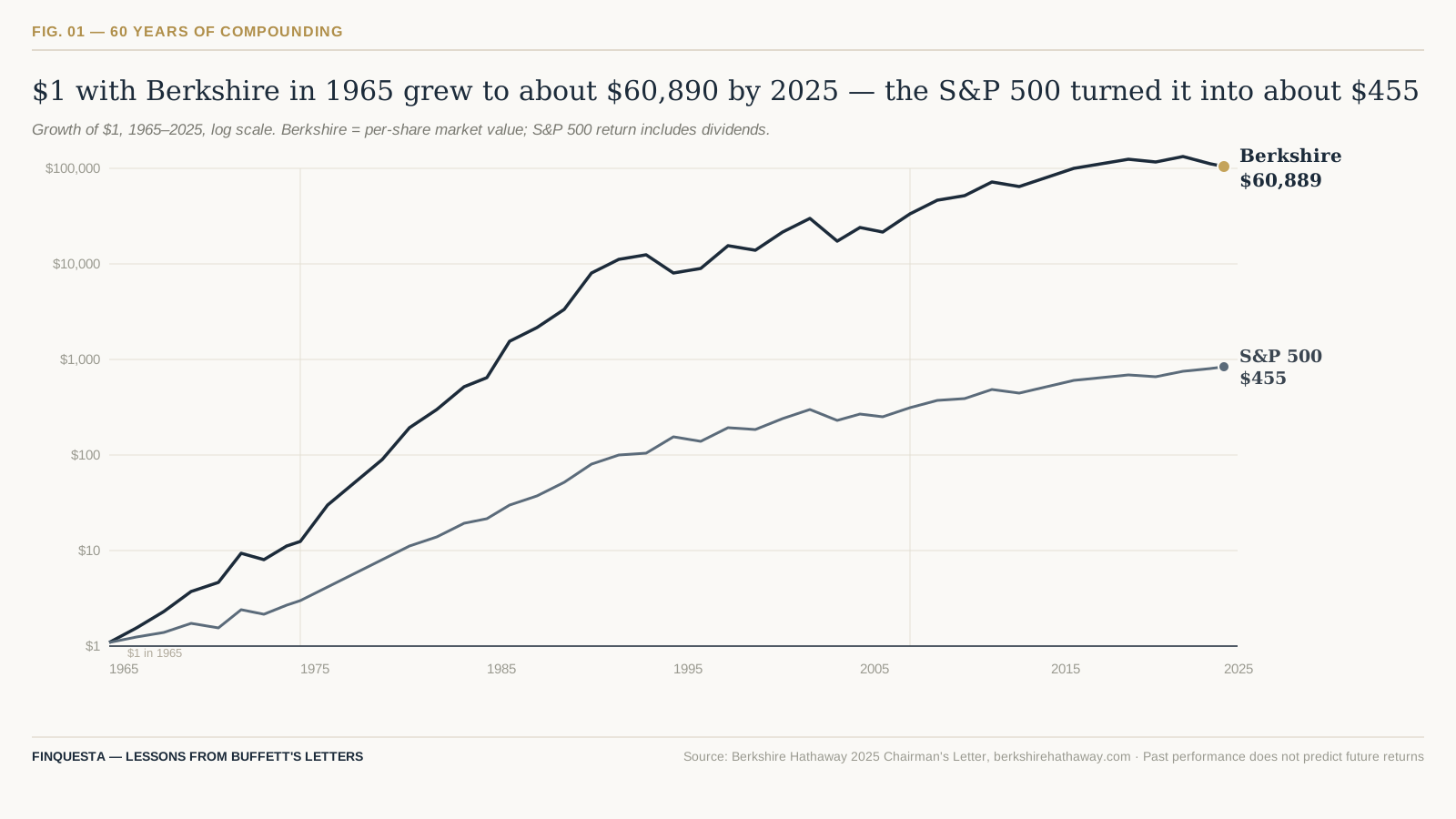
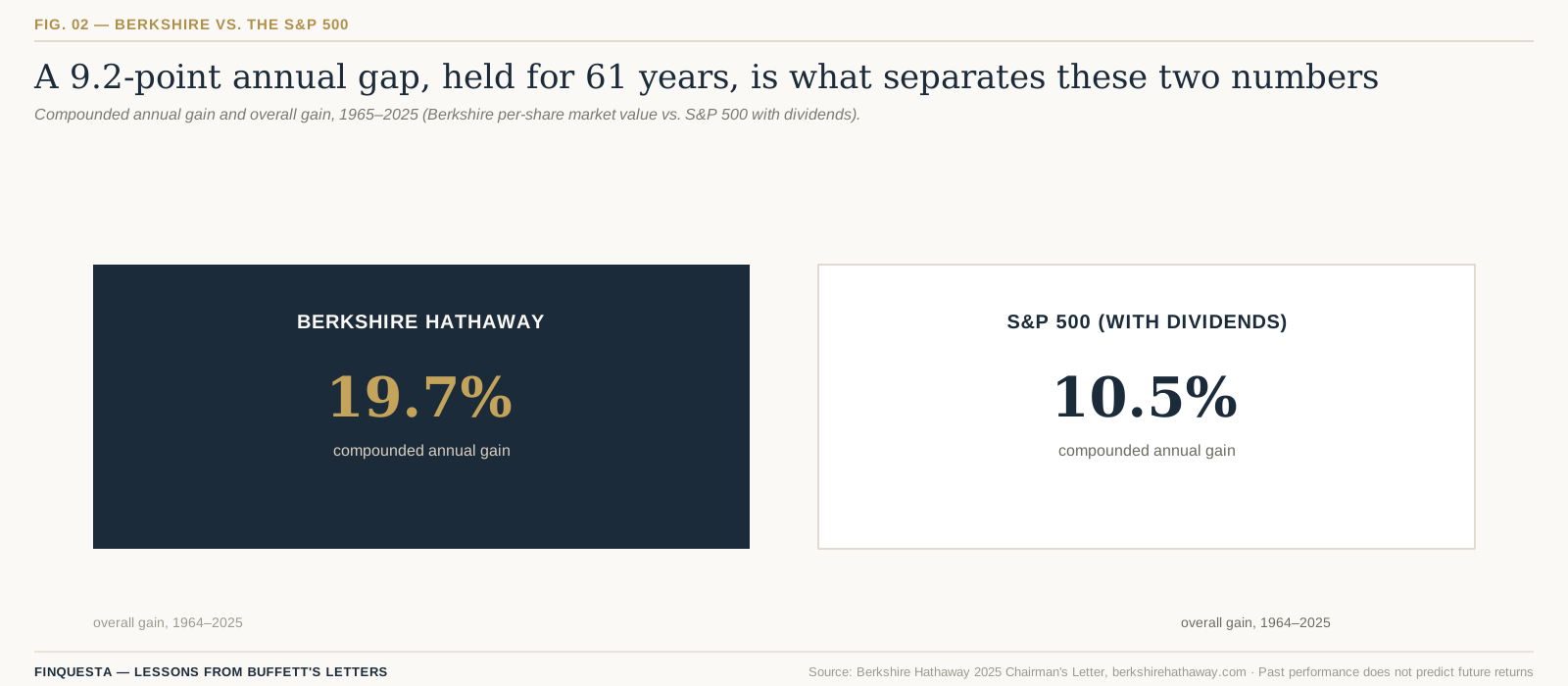
Over 1965–2025, Berkshire’s per-share market value compounded at 19.7% a year. The S&P 500, dividends included, compounded at 10.5% a year. That 9.2-point annual gap, held for six decades, is the entire reason a $1 stake in 1965 grew to roughly $60,890 in Berkshire versus roughly $455 in an S&P 500 tracker.
Two things in that table matter more than the headline number. First, Berkshire didn’t win every year — it lost badly in 1974 (-48.7%), 1990 (-23.1%), 1999 (-19.9%), and 2008 (-31.8%), each time in a year the S&P 500 also fell or came close to it. An investor watching only the down years would have seen four separate reasons to quit.
Second, the gap between the two lines didn’t come from avoiding those bad years at all. It came from what happened in the years in between them, which is the actual subject of nearly every lesson in this guide. Skimming past the losing years to get to the compounding is exactly the habit this article is trying to talk you out of.
None of this happened in a vacuum, either. The same discipline that built the scorecard is still visible in how Berkshire deploys capital today: in 2025 alone, Abel’s team added two very different businesses to Berkshire — OxyChem, an industrial chemicals producer, and Bell Laboratories, a family-owned pest-control company whose owner wrote directly to Buffett describing a durable, easy-to-understand business with a strong management team. Neither purchase makes headlines the way a flashy tech acquisition would. That’s rather the point of the whole approach.
Circle of Competence: Buffett’s First Rule for Not Losing Money
In his 1996 letter, Buffett laid out the idea most people now know by a three-word label — circle of competence — though that exact phrase is a later shorthand rather than his own original wording. His own words were plainer: an investor doesn’t need to understand every company, only the ones inside the boundary of what they actually understand. Knowing where that boundary sits, he wrote, matters more than how large the circle is.
Greg Abel’s 2026 letter borrowed a sports analogy Buffett had used for decades to describe the same discipline. Buffett drew inspiration from Ted Williams, the baseball Hall of Famer who divided the strike zone into 77 cells and swung only at pitches in his highest-percentage zone. Williams hit .344 for his career by refusing to swing at anything else. Buffett applied the same logic to companies: wait for the ones you understand well enough to judge, and let the rest go by unswung.
This is where the circle of competence gets misread most often. It isn’t a rule about avoiding complexity — Berkshire owns railroads, reinsurance contracts, and utility infrastructure, none of which are simple businesses. It’s a rule about honesty with yourself, not a rule about difficulty. Buffett passed on internet stocks through the entire dot-com run not because he thought the businesses were too advanced to learn, but because he judged that he couldn’t reliably tell which ones would still exist in ten years.
For an Indian investor scanning a stock screener, the practical version of this lesson is a question, not a rule: could you explain, in three sentences and without jargon, how this specific company will actually make money five years from now? If the honest answer is no, the circle of competence says wait — not never, just not yet, and not on this particular stock until that changes.
The Patience Lesson: Investing to Hold Forever
In his 1989 letter, describing why Berkshire had just bought large stakes in Coca-Cola and Freddie Mac preferred stock, Buffett wrote a line that outlived the specific investments it described: when Berkshire owns part of an outstanding business with outstanding management, “our favorite holding period is forever.”
The line gets quoted often enough that it’s easy to miss what it’s actually claiming. Buffett isn’t saying never sell — Berkshire has sold plenty of positions over the decades, including some he once called permanent. He’s making a narrower claim: the businesses worth owning are worth owning through the discomfort of a bad quarter, a bad year, or in Berkshire’s case, entire bad stretches measured against the index.
Go back to that 60-year scorecard above. Berkshire fell more than 20% in three separate years — 1974, 1990, and 2008 — and each time it went on to post some of its strongest years within the following five. An investor who sold Berkshire stock in early 1975, convinced the -48.7% year proved something was broken, missed a 129.3% recovery the very next year.
The pattern isn’t unique to Berkshire. It’s the mechanical reason patience shows up in almost every durable investing framework, from Buffett’s letters to a plain-vanilla Nifty 50 SIP: most of the compounding happens in a small number of very good years. You only collect them if you’re still holding on the day they arrive, which is a much harder thing to guarantee than it sounds.
Be Greedy When Others Are Fearful — And Vice Versa
Buffett’s contrarian instinct is easy to state and hard to actually practice, which is exactly why it shows up in almost every “Buffett lessons” list you’ll find — usually without an example of what it actually costs to act on it in real time.
Here’s one. In September 2008, with Lehman Brothers days from collapse and the entire financial system visibly seizing up, Berkshire invested $5 billion in Goldman Sachs preferred stock carrying a 10% dividend. Every visible signal in the market that week said retreat. Buffett bought into the panic instead, on terms he’d negotiated because Goldman needed capital and few other buyers were willing to commit it at that specific moment.
The lesson underneath the famous line isn’t simply buy when markets fall. Markets fall often, and plenty of falling markets keep falling for good reason. The lesson is narrower and harder than that: Buffett was only willing to be greedy because he’d already done the circle-of-competence work on Goldman’s underlying business, and the fear in the market that week was about liquidity and sentiment, not about whether the business itself was sound. Contrarian timing without that homework done first isn’t courage — it’s a bet wearing a better story.
Don’t Be a Preening Duck — Judge Yourself Against a Benchmark
In his 1998 letter, reporting on a strong year, Buffett reached for a specific image to warn against a specific mistake: a duck that paddles through a rainstorm and rises with the flood water, then mistakes the rising water for its own paddling skill. He asked shareholders to judge Berkshire’s “duck rating” not by whether it went up, but by how much it went up relative to every other duck on the same pond.
That year, the pond was the S&P 500, and it had risen almost as fast as Berkshire had. This is a harder habit than it sounds, because it cuts both ways. A portfolio up 15% in a year the market is up 25% feels like a win and is actually a loss of relative ground; a portfolio down 10% in a year the market is down 20% feels like a loss and is actually real outperformance.
Most retail investors never build the habit of checking against a genuine benchmark, because checking sometimes tells you your good year wasn’t earned. It was just water.
Bet on the Economy That Employs You
In one of his final traditional letters, Buffett described what he called the American Tailwind: the idea that betting against the country whose growth had done most of the work in Berkshire’s own returns had never once made sense across his 80 years of investing, however loudly any given year’s headlines argued otherwise.
The specific claim in that letter is American. The structure underneath the claim isn’t. Buffett’s point wasn’t patriotism for its own sake — it was that a diversified bet on a large, dynamic, growing economy has historically rewarded patience more reliably than trying to out-guess which sector or which year will outperform next.
For an Indian investor, the same structural logic points toward India’s own growth rather than America’s. A broad-based Nifty 50 or Nifty 500 index fund is a direct, low-cost way to hold that particular bet, without needing to correctly guess which individual company captures the growth first.
It’s worth being precise about what this lesson does and doesn’t say. It isn’t advice to ignore valuation, or to buy any index at any price, at any time. It’s an argument against the specific, recurring mistake of sitting in cash for years because a headline made the near future look uncertain — which, if you check any five-year stretch of financial news, it always does.
The Casino Now Resides in Many Homes: Speculation vs. Investing
In one of his last letters, Buffett drew a line between investing and what markets increasingly reward instead: activity for its own sake. He observed that today’s market participants aren’t more emotionally disciplined than earlier generations were. If anything, the tools for constant trading have moved from a trading floor into everyone’s pocket, and what he called the casino now sits inside people’s own homes rather than a building they’d have to travel to.
The distinction he was drawing matters more now than when he wrote it. An app that makes buying a stock as frictionless as ordering food doesn’t just lower costs — it removes the natural pause that used to sit between an emotional impulse and an executed trade. Buffett’s point wasn’t that trading apps are bad in themselves. It’s that frequent activity isn’t the same thing as good investing, and mistaking one for the other is an expensive way to learn the difference between them.
The Float Multiplier: Why You Can’t Just Copy Buffett’s Returns
Original Finquesta framework.
Here’s the coverage gap in almost every “lessons from Buffett” article: they’ll tell you to hold Coca-Cola forever, and they’ll rarely explain why buying the same stock Buffett bought doesn’t hand you the same result Buffett got. The missing piece isn’t stock selection at all. It’s structural, and it’s called float.
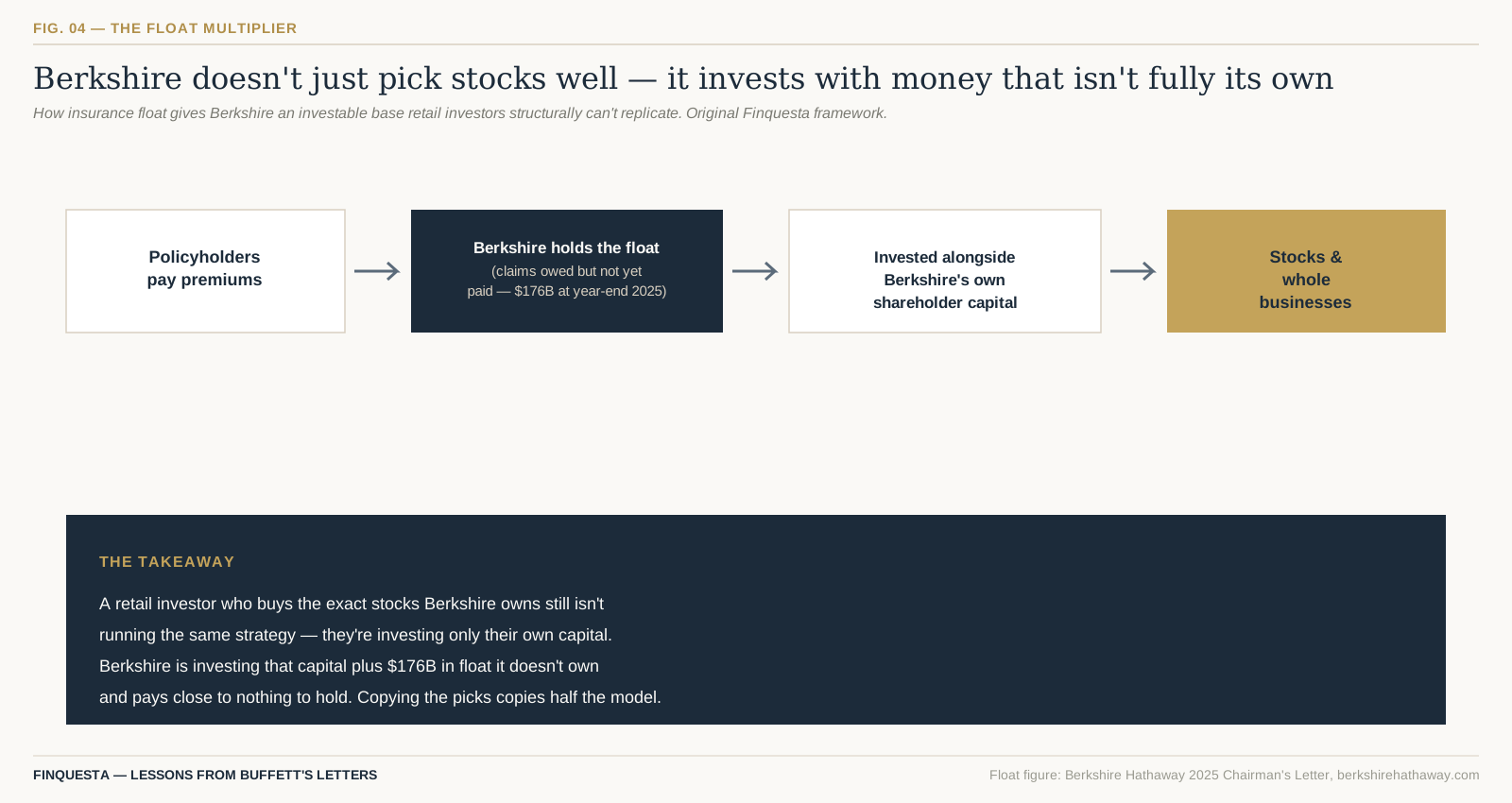
Berkshire’s insurance businesses collect premiums up front and pay claims later, sometimes decades later. In the meantime, that money — the float — sits on Berkshire’s balance sheet. It isn’t Berkshire’s money in an ownership sense; it’s money Berkshire temporarily holds and gets to invest until it’s owed back out. At the end of 2025, that float stood at $176 billion, up from $88 billion just a decade earlier.
Call this the Float Multiplier: Berkshire has spent six decades investing not just its shareholders’ own capital, but a second, enormous pool of money that costs close to nothing to hold and doesn’t have to be repaid on any individual investor’s schedule.
A retail investor who buys Apple, American Express, Coca-Cola, and Moody’s — Berkshire’s four largest holdings, worth a combined $158.6 billion at the end of 2025 — is investing their own capital in the same four companies. They are not investing with a second pool of float sitting alongside it. Copying the stock list copies, at most, half of the actual mechanism.
This isn’t a reason to give up on equity investing — it’s a reason to stop expecting Berkshire’s 19.7% to be a personal benchmark. Even Abel’s own 2026 letter is candid about this ceiling from the inside: at Berkshire’s current size, he wrote, the math of compounding now works against further outsized gains, and the honest goal going forward is steady per-share growth rather than another six decades at the historical rate.
If sheer size works against the $1 trillion company that actually has the float, the comparison was never fair for an individual SIP in the first place. That should be reassuring, not discouraging, once you see why the two numbers were never meant to line up.
The Mistake Ledger: What Buffett’s Biggest Errors Teach You
Original Finquesta framework.
Every “Buffett lessons” article mentions that he admits mistakes. Almost none of them build that habit into something you can actually use yourself. Here’s a working version: four of Buffett’s own admitted errors, in order, each with what it cost and where he said so.
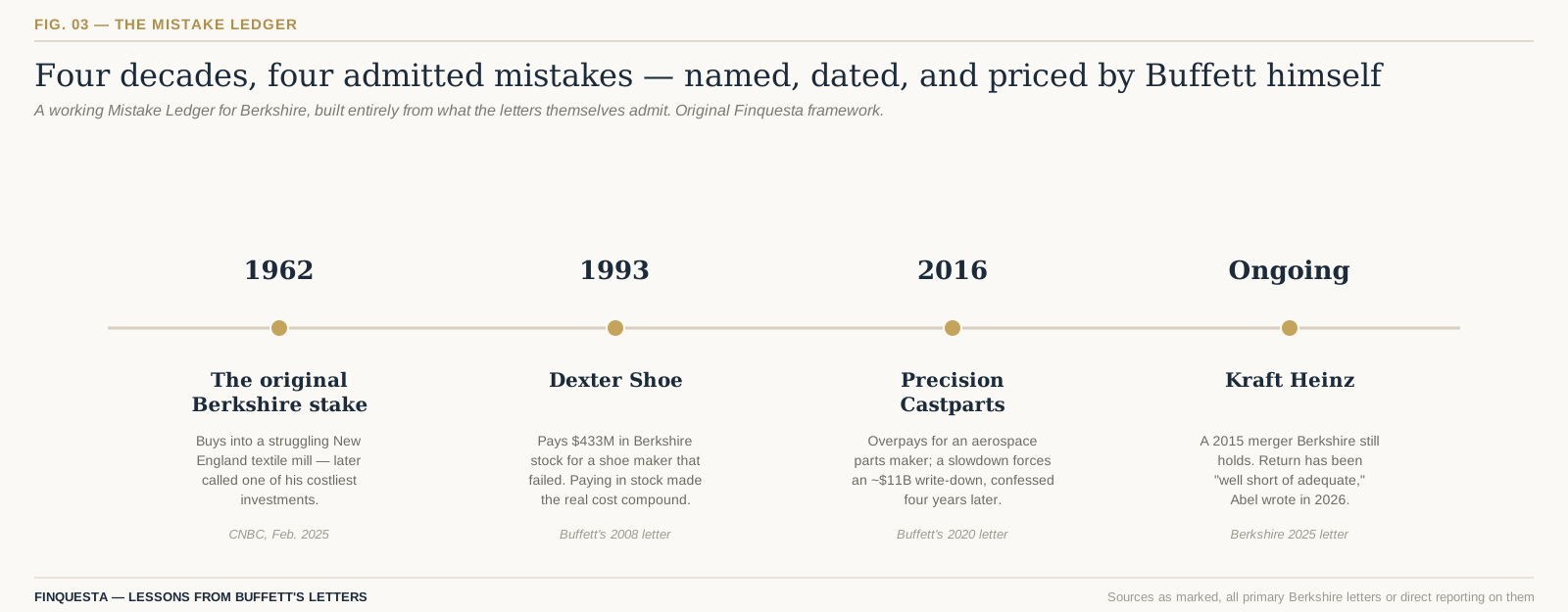
The pattern across all four isn’t the specific mistake — it’s the format of the admission. Buffett didn’t bury these in footnotes or vague language. He named the company, named the number, and named the year, in the same letter format he used to report Berkshire’s wins. That’s the actual transferable habit: not a private promise to never make mistakes, which nobody can honestly keep, but a standing commitment to write down what went wrong, what it cost, and why, on a fixed annual schedule, whether or not anyone asks.
A personal Mistake Ledger doesn’t need Berkshire’s scale to be useful. Once a year — tax season is a natural trigger for Indian investors already gathering financial documents — write down every investment decision you’d genuinely reconsider, what you were thinking at the time, and what actually happened afterward. The value isn’t in the guilt of reviewing it.
It’s in the pattern that emerges after three or four annual entries, which is usually more specific and more useful than “be more careful.” Often it’s something like a recurring tendency to sell winners too early, or to buy only after a stock has already moved — invisible in any single year, obvious across five.
A minimal entry might read: sold a holding in March after a 20% drop, reasoning at the time was fear the decline would continue, and six months later it had fully recovered while the money moved into something that returned less. One sentence, one honest number, no self-punishment attached — just a record you can actually search next year.
What Actually Changes Now That Greg Abel Is CEO
Berkshire shareholders have spent a year absorbing this question, and the honest answer is: less than the headlines suggested, in the parts that matter most to how the company is actually run — and more than zero, in a few specific, named places.
What doesn’t change: Buffett remains Berkshire’s Chairman, in the office five days a week, and Abel’s 2026 letter is explicit that Berkshire continues to draw on his judgment in that role. Berkshire’s decentralized structure — autonomous operating businesses, minimal head-office bureaucracy, managers who think like owners — is the piece Abel’s letter spent the most space defending, quoting Charlie Munger’s own line from 2021 that “Greg will keep the culture.”
What does change: Abel now holds sole capital-allocation authority, a role Buffett held for six decades by himself. Berkshire’s approach to some capital-heavy bets may shift, too — one prominent Berkshire-watcher, quoted in CNBC’s coverage of Abel’s first letter, suggested Abel may prove more willing than Buffett was to deploy Berkshire’s large cash position at today’s rates rather than holding it in short-term Treasuries.
Structurally, the annual letter itself has changed shape. It’s no longer a single founder’s voice reflecting on a year gone by — it’s now a CEO’s letter in a more conventional sense, even with Abel deliberately writing it in Buffett’s spirit and even quoting Buffett directly within it.
Two smaller transitions are unfolding inside the same letter. Marc Hamburg, Berkshire’s CFO for decades, is retiring effective June 2027 and begins handing his responsibilities to successor Chuck Chang in mid-2026. Berkshire also named Mike O’Sullivan as its first-ever General Counsel. Buffett has called Hamburg indispensable to both the company and to himself personally — a reminder that Berkshire’s institutional continuity was never really a one-man operation, even in the decades when the letter carried only one signature.
None of this is a reason to treat Berkshire, or the lessons in its 60-year archive, any differently than before. The letters were never really about one man’s individual stock picks. They were a public record of a specific way of thinking about risk, patience, and honest disclosure — and that record doesn’t get rewritten just because a different person is now holding the pen.
Reading Warren Buffett’s Shareholder Letters as an Indian Investor
Almost everything in Warren Buffett’s shareholder letters was written for an American reader holding American securities, which means the useful move for an Indian investor is translation, not imitation. Three specific gaps are worth naming directly, rather than glossing over.
First, tax treatment. Berkshire pays no dividend and rarely sells, which is itself a tax strategy under the U.S. system — deferring capital gains indefinitely by simply not realizing them. India’s capital gains rules for equity are structured differently, and change often enough with each year’s Union Budget that stating a specific current rate here would go stale fast. Check the current short-term and long-term capital gains treatment for equity directly on the Income Tax Department’s site before making any decision that hinges on holding period.
Second, the specific stocks themselves. Buffett’s four largest U.S. holdings aren’t available to most Indian retail investors without additional cost and complexity: international investment limits, currency conversion, and extra compliance all apply. The lesson worth taking isn’t “buy Apple.” It’s the evaluation process that led there, reapplied to companies actually available on the NSE and BSE.
Third, and most directly useful: Finquesta has already written about the gap between what investors know and what they actually do under pressure, specifically for Indian SIP investors — the tendency to pause or stop a SIP right at the moment a market fall makes it most valuable to keep going.
That behavior gap is the same failure Buffett’s letters warn about, visible in the 1974, 1990, and 2008 rows of his own performance table above. Reading a table of Berkshire’s worst years is a low-stakes way to practice recognizing that feeling before it costs you something in your own portfolio.
Where These Lessons Don’t Translate Directly
A fair account of Buffett’s letters has to include what doesn’t carry over cleanly. This is the section most “Buffett lessons” articles skip entirely, usually because admitting limits is less satisfying to write than admitting genius.
Berkshire buys entire private businesses, not just shares of public ones. A meaningful share of Buffett’s actual edge — the kind described in Abel’s letter as capital deployed with “no financing contingency attached” — comes from being able to acquire whole companies on terms no individual investor can access at all. Circle of competence and patience are genuinely transferable skills. That specific channel of returns simply isn’t, for anyone reading this.
Berkshire’s size is now itself a constraint, not an advantage, by the company’s own admission. Abel’s letter says this plainly: at Berkshire’s scale, the math of compounding works against further outsized growth going forward. A retail investor with a modest portfolio doesn’t share that particular constraint, which cuts both ways — smaller means more flexible, but it also means none of the float, negotiating leverage, or first-call access to deals that make up the rest of Berkshire’s structural edge described in the Float Multiplier above.
And finally, a boundary worth stating outright: this article, like every Finquesta guide, describes how to evaluate an approach. It isn’t a recommendation to buy Berkshire Hathaway shares, any Indian equity, or any specific security, and nothing in it should be read as one.
How to Actually Read an Annual Letter — Yours, Not Just Berkshire’s
The most practical habit in Warren Buffett’s shareholder letters has nothing to do with stock-picking. It’s the discipline of the letter itself: a plain-language, once-a-year account of what happened, what you got right, what you got wrong, and why it happened. Nothing stops an individual investor from writing their own version of one.
Set a fixed date. Buffett’s letters arrived every February without fail, year after year. Pick a date tied to something you already do annually — filing taxes, a birthday, the start of a new financial year — so the review isn’t optional or dependent on your mood that week.
Report the number honestly, first. Write down your actual portfolio return for the year, and the return of a relevant benchmark like the Nifty 50 or Nifty 500 for the same period, before you write anything else. This is the preening-duck check from earlier in this guide, applied to your own year instead of Berkshire’s.
Name one mistake and one thing that worked. Not vaguely — specifically, with the decision, your reasoning at the time, and what actually happened afterward. This is a Mistake Ledger entry in miniature, and it’s the single habit most likely to change your decisions the following year.
Write it down, not just think it. The difference between a genuine annual review and a vague New Year’s resolution is that Buffett’s version existed on paper, was dated, and could be checked against next year’s letter. A note in your phone that you’ll actually reread in twelve months does the same job just as well.
Reread last year’s before you write this year’s. Buffett’s letters gained their power cumulatively — each one assumed the reader remembered the last one’s admissions and promises. Five minutes with your own prior entry, before writing a new one, is what turns a snapshot into an actual track record.
Common Myths About Buffett’s Investing Style
| Myth | What the letters actually show |
| Buffett trades constantly to stay ahead of the market | Berkshire’s hallmark is extremely low turnover — some positions have been held for decades, and Buffett has repeatedly said his favorite holding period is forever |
| Buying Berkshire stock today recreates Buffett’s historical returns | Past compounding at 19.7% a year reflects six decades of float, deal access, and a smaller starting size — Abel’s own letter says Berkshire’s current scale now works against repeating that rate |
| Buffett has never made a serious investing mistake | Buffett named and priced his own errors publicly nearly every year, including Dexter Shoe, Precision Castparts, and the original Berkshire textile business itself |
| Circle of competence means only investing in simple businesses | It means only investing where you can judge the underlying economics — Berkshire owns railroads and reinsurance contracts, neither of which is simple |
| Buffett is against ordinary people buying index funds | He has repeatedly recommended low-cost index funds for investors who don’t want to actively evaluate individual businesses themselves |
Frequently Asked Questions
What is Warren Buffett’s most famous shareholder letter lesson?
The most quoted line is probably his 1989 remark that when Berkshire owns part of an outstanding business with outstanding management, its favorite holding period is forever. It’s less a rule against ever selling and more an argument for judging businesses by their multi-decade economics rather than their next quarter.
Is Warren Buffett still writing Berkshire Hathaway’s annual letter?
No. Buffett wrote every annual letter from 1965 through the letter covering 2024 results, published in February 2025. He announced in a November 2025 Thanksgiving letter that he was stepping down as CEO and would no longer write the annual report. Greg Abel, Berkshire’s new CEO, wrote the first Abel-authored annual letter in February 2026.
What is Berkshire Hathaway’s average annual return?
Per Berkshire’s own reported table, Berkshire’s per-share market value compounded at 19.7% annually from 1965 through 2025, versus 10.5% for the S&P 500 with dividends included. That historical rate isn’t a forecast: Berkshire’s own 2026 letter notes that the company’s current size now works against repeating it going forward.
Can I read Warren Buffett’s shareholder letters for free?
Yes. Berkshire Hathaway publishes the full archive of annual letters, going back to 1977 in original form, free on its official website, with no signup or payment required.
What is Warren Buffett’s “circle of competence”?
It’s the idea, from his 1996 letter, that an investor doesn’t need to understand every company — only the ones inside the boundary of what they can genuinely evaluate. Buffett has said the size of that circle matters less than knowing exactly where its edges sit.
Should Indian investors copy Warren Buffett’s stock picks?
Not directly. Buffett’s largest holdings are U.S. stocks with different tax treatment, currency exposure, and access requirements for Indian residents. The transferable part is his evaluation process — circle of competence, patience, and judging performance against a benchmark — reapplied to companies actually available on the NSE and BSE.
What was Warren Buffett’s biggest investing mistake?
Buffett named several candidates himself across different letters, including the original 1962 purchase of Berkshire Hathaway as a textile company, and the 1993 Dexter Shoe acquisition, which he called his worst deal in his 2008 letter because he paid $433 million in Berkshire stock that would otherwise have kept compounding for decades.
Who is Greg Abel, and why does he matter to Berkshire shareholders?
Greg Abel became Berkshire Hathaway’s CEO on January 1, 2026, succeeding Warren Buffett, who remains Chairman. Abel previously ran Berkshire’s non-insurance operations and was publicly named as Buffett’s chosen successor years before the transition took effect. His February 2026 letter was the first Berkshire annual letter not written by Buffett since 1965.
What is Berkshire Hathaway’s “float,” and why does it matter?
Float is the pool of premium money Berkshire’s insurance businesses hold temporarily before paying out claims. It stood at $176 billion at the end of 2025. Berkshire invests this money alongside its own shareholder capital, a structural source of its returns that an individual investor copying Berkshire’s stock holdings does not have access to.
How is Buffett’s approach different from just buying an index fund?
Buffett actively evaluates individual businesses within his circle of competence, while an index fund buys the entire market without that judgment. Notably, Buffett himself has repeatedly told most ordinary investors to skip individual stock-picking altogether and buy low-cost index funds instead — advice that sits somewhat apart from how Berkshire itself actually invests its own capital.
Does Berkshire Hathaway pay a dividend?
No. Berkshire has never paid a cash dividend under Buffett’s tenure, and Abel’s 2026 letter confirms the policy continues: the company won’t pay one as long as each retained dollar is reasonably likely to create more than a dollar of market value for shareholders. The Board reviews this policy every year.
What happened to Warren Buffett’s Thanksgiving letter tradition?
It continues. Even after stepping down as CEO and handing off the formal annual shareholder letter, Buffett said in November 2025 that he would keep sending a personal Thanksgiving letter to shareholders and his children each year — a smaller, separate tradition from the annual report he no longer writes.
Disclaimer
This article is for informational and educational purposes only and does not constitute financial, investment, tax, or legal advice. Figures, rates, and regulations mentioned are subject to change; please verify current details with official sources (RBI, SEBI, the Income Tax Department, IRS, or a licensed financial advisor) before making financial decisions. Finquesta may earn a commission from affiliate links in this article at no extra cost to you.