
| WHAT IS AN EMERGENCY FUND? An emergency fund is money kept in an easily accessible account, separate from everyday spending, meant to cover a genuine income loss or unavoidable expense without relying on debt. Anyone with recurring expenses needs one — salaried employees, freelancers, and business owners alike — though the right amount varies sharply between them. Most advisors suggest starting with a small buffer, then building toward three to six months of essential expenses. The money belongs in a liquid, low-risk account — a savings account, sweep-in fixed deposit, or liquid fund — not equities or anything that can lose value right when you need it. |
Table of Contents
Meera runs a freelance graphic design studio out of Bangalore. In a good month she bills somewhere between ₹70,000 and ₹1,20,000 — enough to live well, save a little, and not think too hard about the gap between her best month and her worst one. Then a long-standing client restructures its marketing budget, two other projects get shelved in the same week, and her income for the next quarter drops to almost nothing. She isn’t broke. She has investments, no debt, and a healthy credit score. What she doesn’t have is cash she can spend today without selling something or asking someone. That gap — between being financially fine on paper and being able to actually pay this month’s bills — is exactly what an emergency fund exists to close.
Ask most people how big that fund should be, and you’ll get the same answer everywhere: three to six months of expenses. It’s not wrong. It’s also not specific enough to be useful. A salaried employee with health insurance and a working spouse needs a different number than a freelancer with one big client. This piece exists to turn “three to six months” into an actual number for your situation, and to be honest about what that number should and shouldn’t include.
What the Numbers Say About Who’s Actually Prepared
It’s worth pausing on the scale of the gap before getting into the framework, because it explains why this topic never stops being relevant. Bankrate’s 2026 Annual Emergency Savings Report, based on a national survey fielded in December 2025, found that only 47% of Americans said they had enough liquidity to cover a $1,000 emergency expense (source: Bankrate, “Bankrate’s 2026 Annual Emergency Savings Report,” bankrate.com, published February 4, 2026). Nearly a quarter of respondents — 24% — reported having no emergency savings at all, and only 46% had enough to cover even three months of expenses, despite 85% saying they’d need at least that much to feel comfortable.
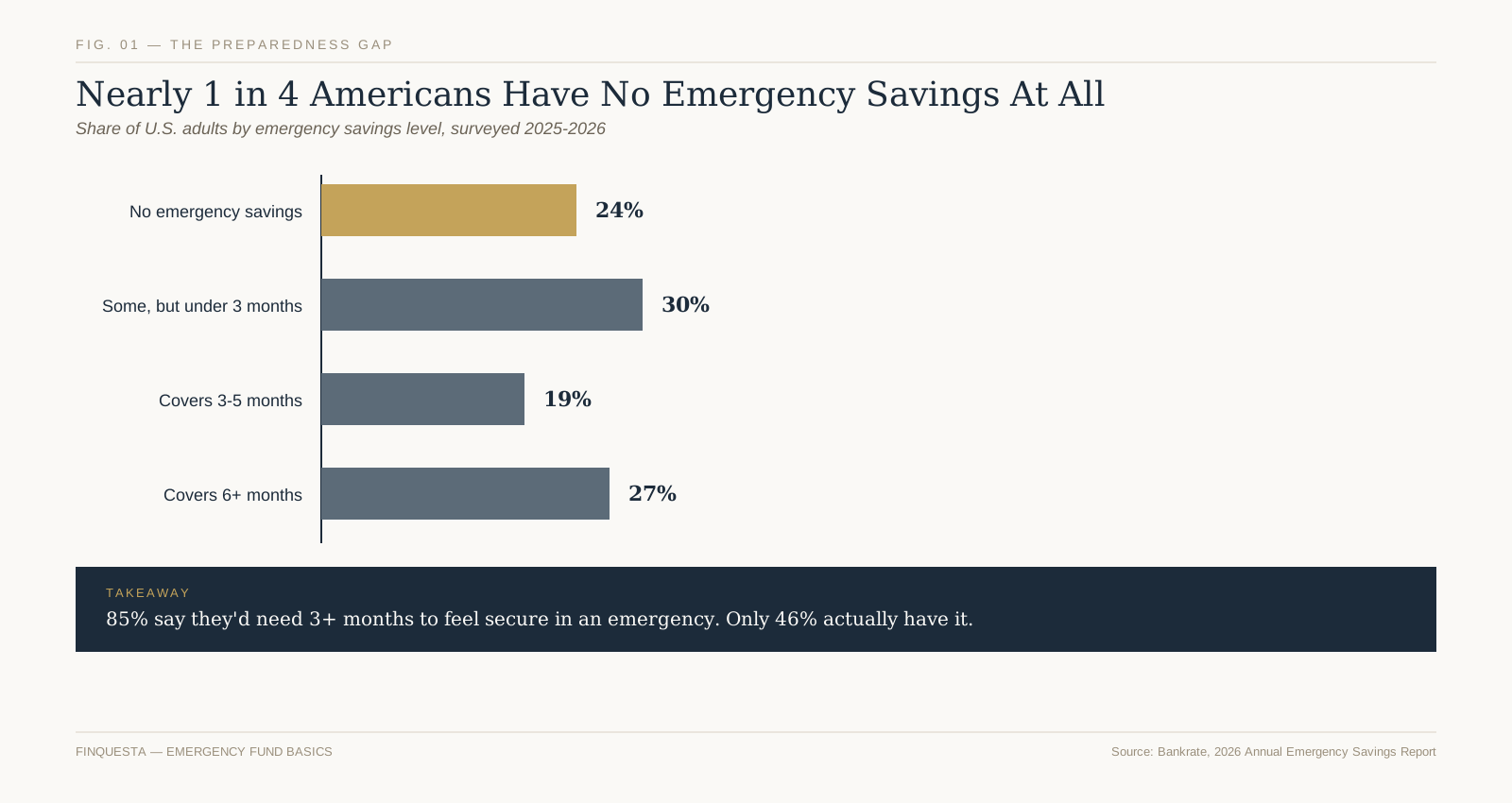
FIG. 01 — The Preparedness Gap
The US Federal Reserve’s Survey of Household Economics and Decisionmaking, covering 2025 and published in May 2026, tells a similar story from a different angle: 63% of adults said they could cover a $400 surprise expense using cash or its equivalent, and 55% had specifically set aside enough to cover three months of an income loss (source: Board of Governors of the Federal Reserve System, “Report on the Economic Well-Being of U.S. Households in 2025,” federalreserve.gov, May 2026).
Both figures were essentially unchanged from the year before — this isn’t a one-year blip, it’s a persistent, structural gap between the standard advice and what people actually have set aside.
The picture looks similar in India, if less thoroughly surveyed. A 2025 survey of 1,720 users by Indian savings platform Stable Money found that nearly half — 47.4% — had saved less than a tenth of the emergency fund they’d calculated they needed (source: Stable Money, “Emergency Fund Gap” case study, stablemoney.in, 2025).
None of this means the three-to-six-month guidance is wrong. It means most people never arrive at a number that feels both correct and achievable enough to actually hit — and that’s the gap this article is built to close.
What Actually Counts as an Emergency (and What Doesn’t)
Before sizing the emergency fund, it’s worth being precise about what it’s for, because it only works if it’s protected from everyday scope creep. A genuine emergency has three features: it’s unplanned, it’s necessary, and delaying it would cost you more than paying for it now. A job loss fits. A medical bill fits. A car or bike repair that’s the difference between getting to work and not fits. A wedding gift, a flash sale, a trip that came up, or a phone upgrade do not — however real the desire to spend on them might feel in the moment.
This distinction matters because Bankrate’s same 2026 survey found that among people who’d tapped their emergency savings in the past year, 80% used it for essentials — an unplanned bill, monthly rent or utilities, or day-to-day costs — while a smaller share, under one in five, used it for non-essentials like a vacation or discretionary shopping. The fund holds up as a safety net precisely because most people, most of the time, use it the way it’s designed to be used. The moment it becomes a backup shopping budget, the number you calculate below stops meaning anything.
A useful gut check: if you can delay the expense a month without real consequence, it’s not an emergency yet — it’s a decision. If delaying it creates a cascading cost (a late fee, a missed diagnosis, a lost client), it qualifies.
Two edge cases that often get miscategorized in both directions: an annual insurance premium is not an emergency, even though it’s large and arrives once a year, because it’s entirely predictable and belongs in the regular budget instead. A sudden, necessary vet bill or a family member’s urgent medical cost, on the other hand, usually is one, even though nobody would have listed it as a line item in advance.
Why “Three to Six Months” Isn’t Wrong — Just Incomplete
Nearly every bank, robo-advisor, and finance blog converges on the same range, and for good reason: three to six months of expenses covers the length of a typical job search for a stable, in-demand role, without being so large that building it feels pointless. The trouble is that the range hides two very different numbers inside it, and almost nobody tells you which end applies to you.
The rule also tends to get applied to the wrong base number. Several major sources — Chase, Ally, and Fidelity among them — are careful to specify that the multiplier should apply to essential expenses, not your full salary or current lifestyle spending. That’s the right instinct, but “essential” is still a fairly blunt cut. Rent counts as essential, obviously — but does your full grocery budget count the same way a bare-bones one would? Does your gym membership? Most calculators don’t go far enough to answer that, which is where the next two sections come in.
The Stability Score: A Faster Way to Size Your Emergency Fund
Original Finquesta framework
Instead of guessing whether you’re a “three month person” or a “six month person,” the Stability Score turns the decision into simple arithmetic. Start at a base of three months, then add for each factor below that applies to you:
- Income source: Salaried at an established employer, +0. Salaried but the role is fully commission-based or highly cyclical, +2. Self-employed, freelance, or gig-based, +3.
- Number of income earners in the household: Dual income, both stable, +0. Single income, +2.
- Dependents: None, +0. Children, aging parents, or anyone else financially reliant on you, +1.5.
- Insurance coverage: Adequate health insurance and, if you have dependents, term life cover, +0. Gaps in either, +1.5.
- Re-employment speed in your field: Roles that are typically filled within weeks (high-demand, transferable skills), +0. Roles with long hiring cycles, niche specializations, or senior-only openings, +2.
Add the applicable points to the base of three, and round to the nearest whole month. A salaried employee in a dual-income household, insured, in a fast-hiring field, lands at exactly three months — the low end of the standard range, and correctly so. A single-income freelancer supporting a child, with an insurance gap, lands closer to nine or ten. Both are “following the three-to-six-months rule” in spirit; only one of them is actually protected.
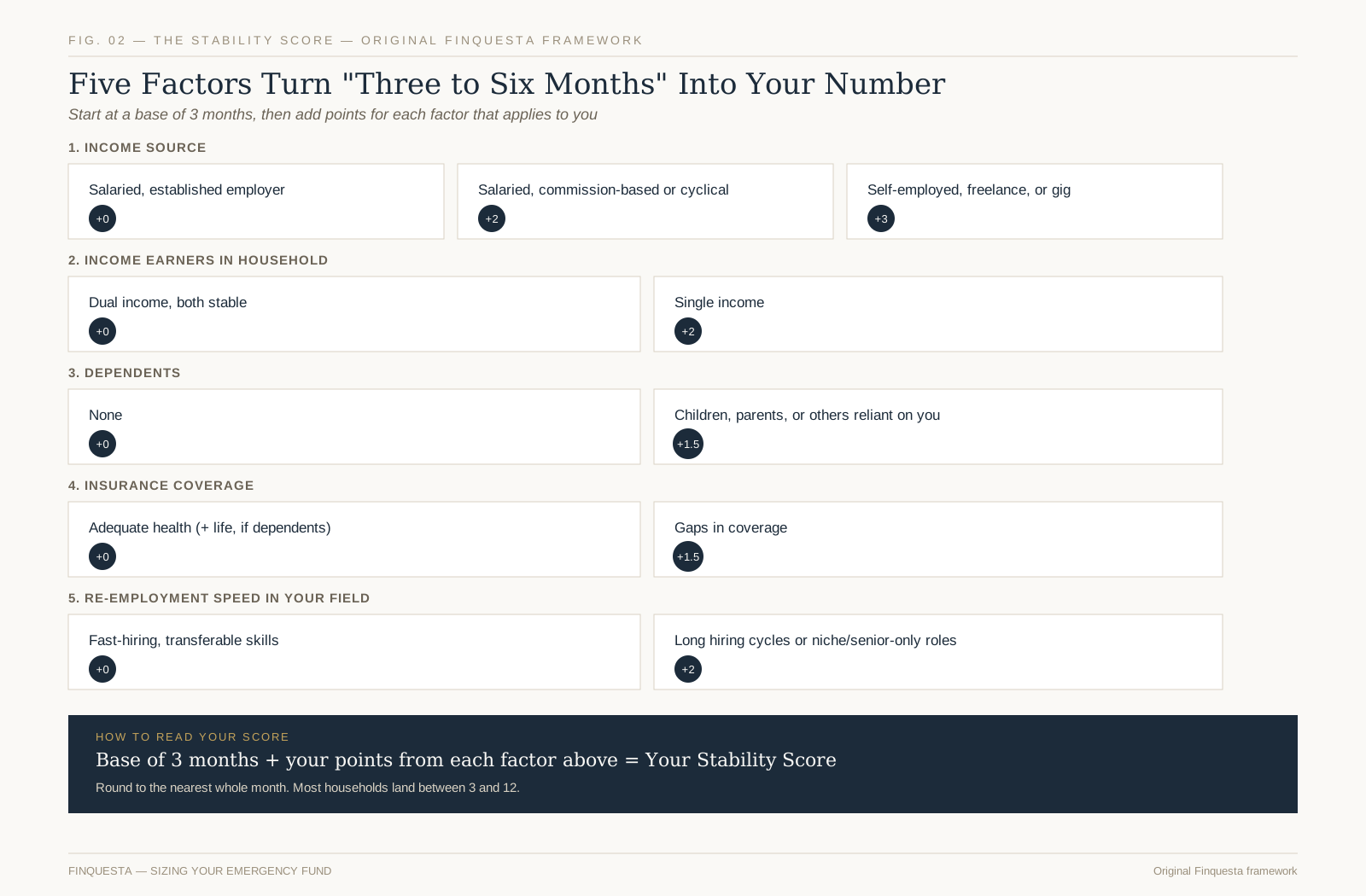
FIG. 02 — The Stability Score
The score deliberately doesn’t go below three months for anyone, even someone who scores zero on every factor, because unexpected expenses (as opposed to income loss) can hit even the most stable household, and three months is a sensible floor for that alone. It also doesn’t have a hard ceiling — if your factors keep adding up, that’s useful information, not a flaw in the framework.
The Expense Floor: What Your Number Is Actually Multiplying
Original Finquesta framework
Once you know your target number of months, the next question is: months of what, exactly? Most people multiply their number by their full current monthly spending, which inflates the target and makes it feel out of reach. The Expense Floor method fixes this by splitting spending into three tiers before you multiply anything.
Tier 1 — The Floor. What you cannot avoid paying even in a genuine crisis: rent or EMI, utility connections, insurance premiums, minimum debt payments, and a bare-bones grocery budget. This is the number that should actually get multiplied by your Stability Score.
Tier 2 — Reducible essentials. Costs that continue but could be cut hard for a few months without real harm: your full (rather than bare-bones) grocery spend, transport, phone and internet plans, and similar recurring costs. Worth tracking, but not the number to size your fund against.
Tier 3 — Discretionary. Dining out, entertainment, subscriptions you’d cancel without much thought, shopping, and travel. This tier effectively disappears the day an emergency starts, which is exactly why it shouldn’t inflate your target.
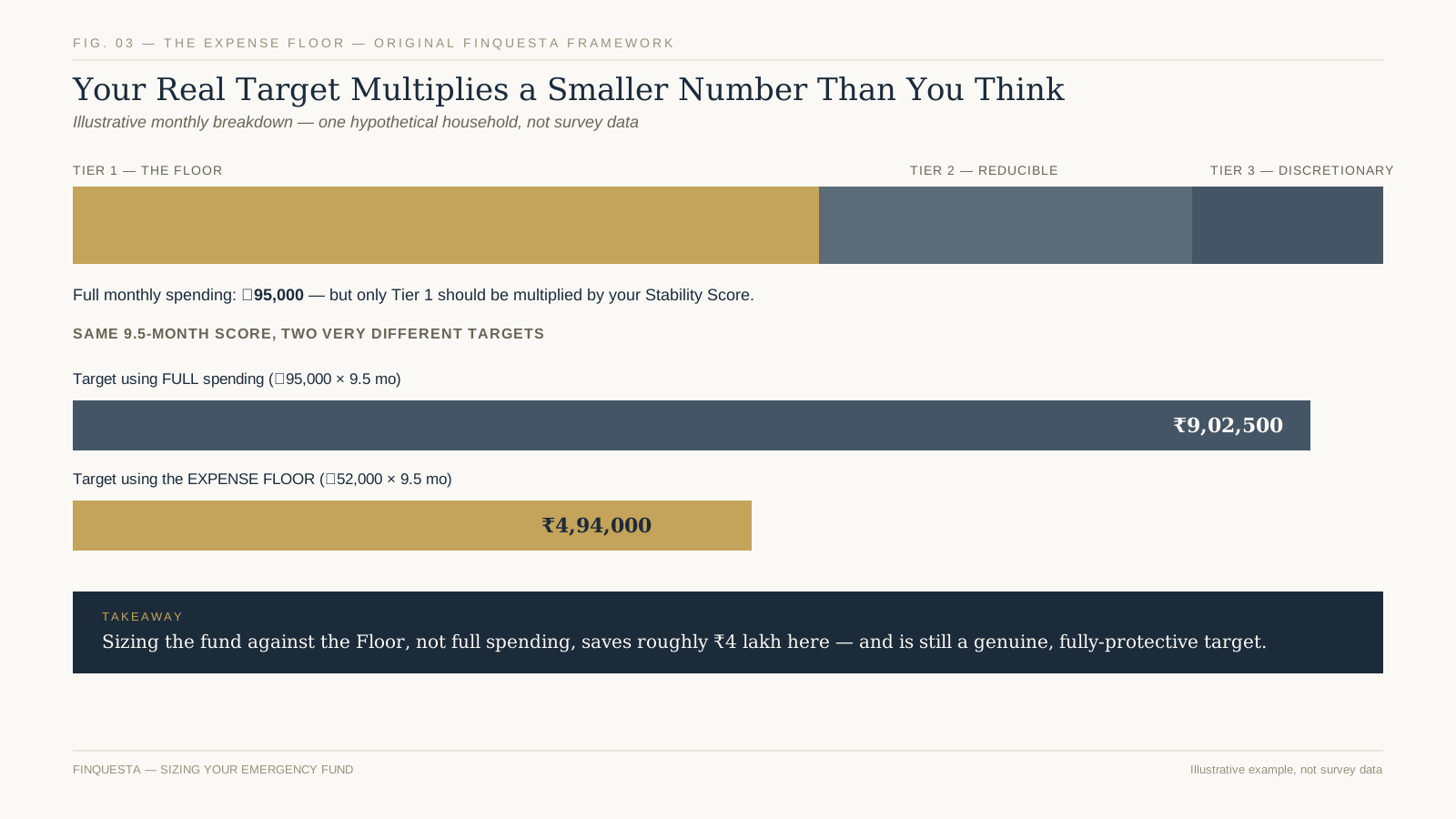
FIG. 03 — The Expense Floor
The gap between Tier 1 and your full current spending is usually larger than people expect — often a third or more of the total — which means a fund sized against the Floor, rather than against everything you currently spend, is both more accurate and considerably faster to reach. This doesn’t mean Tiers 2 and 3 don’t matter; it means they belong in your monthly budget, not in the emergency-fund target.
A Quick, Worked Example: Sizing One Emergency Fund End to End
Back to Meera. Her current monthly spending, all in, runs about ₹95,000. Applying the Expense Floor: her Tier 1 (rent, a health insurance premium, utilities, minimum EMI on a laptop loan, and bare groceries) comes to roughly ₹52,000. Tiers 2 and 3 — the rest of her groceries, transport, subscriptions, and the dining and shopping she’d happily cut for a few months — make up the remaining ₹43,000.
Her Stability Score: self-employed and fully variable income (+3), single income with no other earner in the household (+2), no dependents (+0), an insurance gap since she’s never bought term cover (+1.5), and a field — freelance design — that hires reasonably fast for good portfolios (+0). Base of 3, plus 6.5, rounds to roughly 9–10 months.
Nine and a half months against a Floor of ₹52,000 is about ₹4.9 lakh — a real number, and still a large one, but noticeably more achievable than nine and a half months against her full ₹95,000 in spending, which would put the target above ₹9 lakh. The framework doesn’t make the number small. It makes the number honest, and honest numbers are the ones people actually save toward.
Figures in this example are illustrative and constructed for demonstration only — they are not survey data or typical-case averages.
How Much Emergency Fund You Need, By Situation
For a faster read, here’s how the Stability Score tends to land across common situations. Treat these as starting estimates, not a replacement for running your own numbers above.
| Situation | Typical range | Why |
| Salaried, dual income, no dependents, insured | 3–4 months | Lowest-risk combination; two incomes rarely fail at once |
| Salaried, single income, no dependents, insured | 4–5 months | One point of failure, but no dependents to protect |
| Salaried, single income, with dependents | 6–8 months | One point of failure, and the cost of that failure is higher |
| Freelance, commission-based, or gig income | 6–10 months | Income variability is the dominant factor regardless of household structure |
| Business owner (business is the income source) | 9–12 months | The “job” and the “employer” are the same entity — no separation between the two risks |
| Near-retirement or retired, drawing down savings | 12–24 months | Sequence-of-returns risk means a market downturn plus a cash need can compound badly |
Where Priority Should Sit: Emergency Fund vs. Debt vs. Investing
A fair question once the target number exists: should it come before paying off debt, or before investing? Bank rate’s 2026 data shows real people split roughly three ways on this already — 29% prioritize savings, 21% prioritize debt paydown, and 31% try to do both at once. A reasonable sequence, in order:
- A small starter buffer first — often cited around $500–$1,000 or roughly ₹15,000–₹25,000 — before anything else, so a minor surprise doesn’t immediately become new debt.
- High-interest debt next, credit cards especially. The interest saved by clearing a card charging 30%+ APR almost always outweighs what the same money would earn sitting in a liquid fund or savings account.
- Back to the emergency fund, building it to your full Stability Score target.
- Investing surplus beyond the fund, once the target is fully met.
The one exception: if your income is unstable enough that a gap could force you into new high-interest debt regardless, building the fund further before aggressively attacking existing debt can be the more defensive move — this is a judgment call based on your own volatility, not a universal override of the sequence above.
Where to Actually Keep an Emergency Fund
The fund needs to be liquid, low-risk, and separate enough from everyday spending that it doesn’t quietly get absorbed into it. Beyond that, the right instrument differs by country.
In India, the emergency fund is typically split across two or three of the following: a plain savings account for instant access, a sweep-in fixed deposit (which auto-converts idle balances above a threshold into a short FD and sweeps them back on demand), and a liquid or overnight mutual fund for the portion you’re less likely to need same-day. Liquid funds are a category of mutual fund — the same wrapper used for far more volatile equity schemes — so if you’re new to how funds work generally, it’s worth understanding the basics first. Bank deposits in India are insured by the DICGC up to ₹5 lakh per depositor per bank, covering both principal and interest combined.
In the US, UK, and other markets, the equivalent split is usually a checking account for instant access, paired with a high-yield savings account or money market account for the bulk of the emergency fund. In the US, standard FDIC deposit insurance covers up to $250,000 per depositor, per insured bank, per ownership category. A CD or fixed-term deposit can hold a small slice of a very large fund, but avoid locking up more than you’re confident you won’t need before maturity — early withdrawal penalties defeat the purpose.
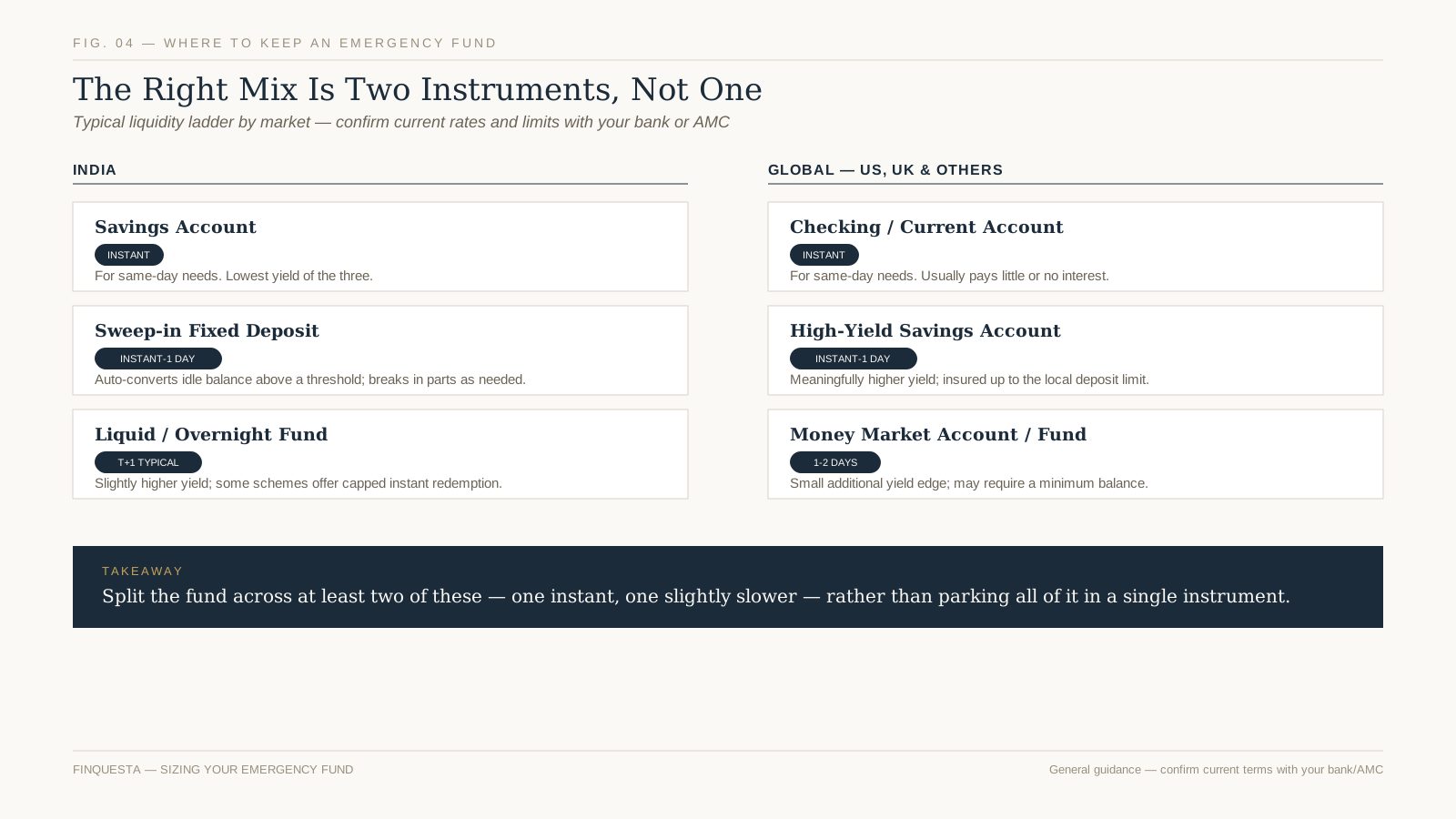
FIG. 04 — Where to Keep an Emergency Fund
Whichever country you’re in, a workable split looks roughly like: one part instantly accessible for genuine same-day needs, and the remainder in something that pays a little more while still settling within a day or two. Don’t let the pursuit of yield push any of it into an instrument that can drop in value or lock you out when you actually need it.
One instrument worth being wary of in either market: cash sitting in a zero-interest current or checking account “for safety.” It’s liquid, but it quietly loses purchasing power every year to inflation — the one risk an emergency fund can’t avoid just by sitting still. The fund doesn’t need to beat inflation, but it should at least keep pace, which a plain non-interest account never will.
Can Part of It Work a Little Harder?
Once a fund grows past six or so months of the Floor, a fair question comes up: does all of it really need to sit in the lowest-yielding option available? For the bottom layer — the portion you might need same-day — no shortcuts. But the top layer of a larger fund, the part you’re unlikely to touch inside a week even in a real emergency, can reasonably sit in short-duration instruments that still prioritize capital preservation: a liquid fund rather than a plain savings account, or in some markets a short-term government treasury bill accessed through a demat and trading account.
The distinction to hold onto: this is about slightly better cash management, not investing. If an instrument can meaningfully drop in value over the holding period you’d need it for, it doesn’t belong in the emergency fund, no matter how good the historical yield looks. Any extra yield is also taxable — as per your income slab in India, or largely at ordinary income rates in the US — so factor that in before assuming a marginally higher-yielding option is meaningfully better; the after-tax gap is often smaller than the headline rate difference suggests.
Money that’s genuinely available for investing — because your full fund target is met and this is surplus — is a separate decision with a different time horizon and risk tolerance, worth planning deliberately rather than folding into the emergency allocation by default.
Building It Without Wrecking Your Monthly Budget
The gap between “I should have an emergency fund” and “I have one” is usually a budgeting problem, not a willpower problem. A workable build sequence:
- Set a starter target, not the full number — a small buffer you can hit within a month or two, so the habit starts before the size of the full goal has time to feel discouraging.
- Automate a fixed transfer on payday, before the money has a chance to be allocated elsewhere. The amount matters less than the consistency.
- Route windfalls in, at least partially — bonuses, tax refunds, gifts, and one-off payments are the fastest way to make real progress without touching monthly cash flow.
- Build toward the full Stability Score target, tracking progress in months-covered rather than a raw number, since months-covered is the metric that actually reflects your protection.
- Loop back to step 2 after any withdrawal. A fund that isn’t replenished quickly is a fund that will eventually be empty exactly when it’s needed.
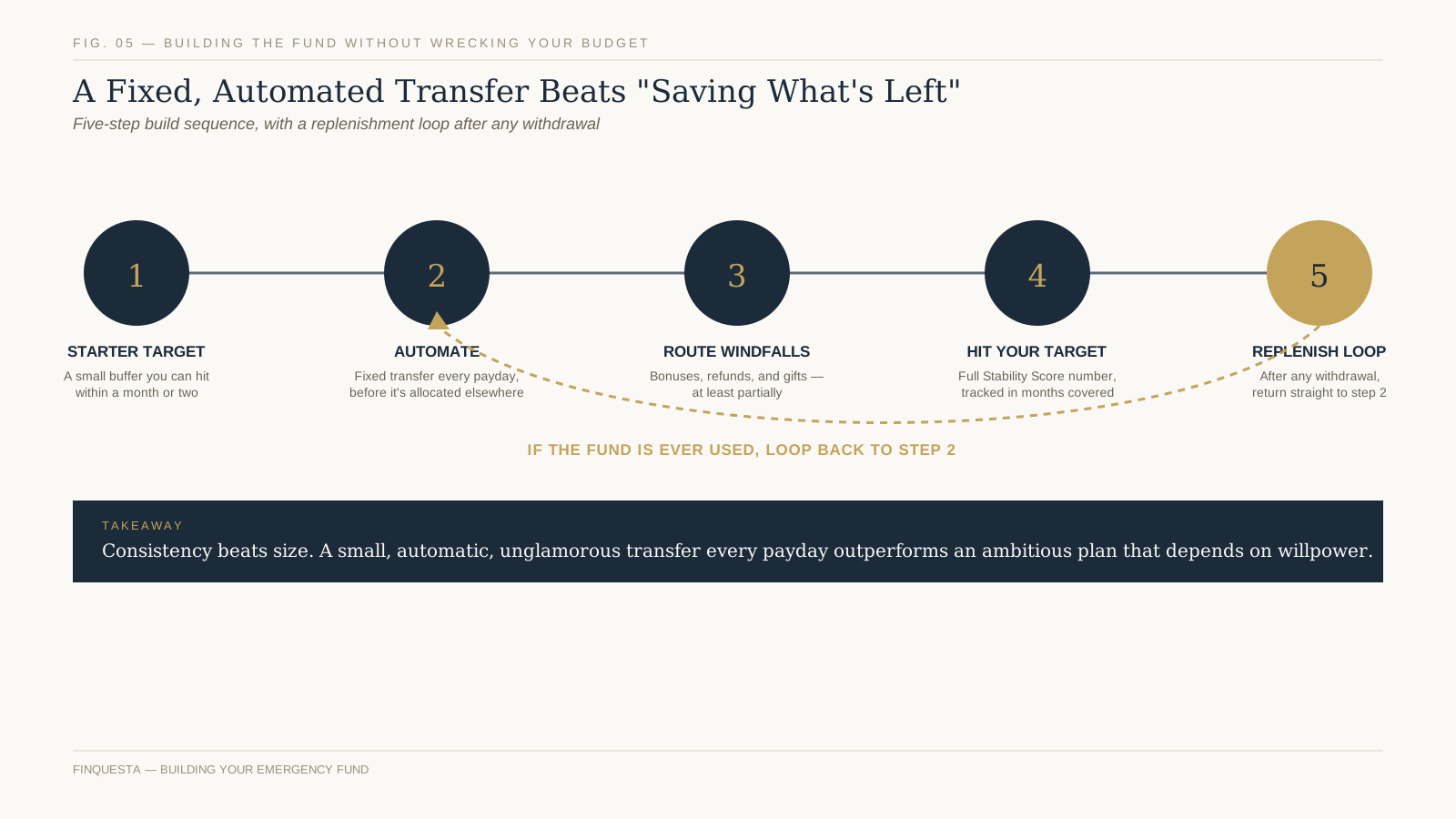
FIG. 05 — Building the Fund
None of this requires a dramatic lifestyle change. A fund built from a fixed, automated, unglamorous transfer every payday reliably outperforms one that depends on remembering to “save what’s left” — because for most households, on most months, there isn’t anything left by design.
How Often to Recalculate Your Number
A Stability Score and an Expense Floor calculated once and never revisited quietly go stale, usually in one of two directions. Life changes shift the Stability Score itself — a new dependent, a job switch into a less stable field, a lapsed insurance policy, or a household going from two incomes to one are each reason enough to rerun the calculation immediately, rather than waiting for a scheduled review.
The Expense Floor drifts for a quieter reason: inflation. Bankrate’s 2026 report found that 54% of Americans say rising prices are causing them to save less for emergencies — and the same rising prices mean the Floor calculated two years ago is very likely understating what three to six months of rent, utilities, and groceries actually costs today. A fund that was correctly sized in 2024 can be meaningfully undersized by 2026 without a single rupee or dollar having been withdrawn from it.
A simple annual habit avoids both problems: recalculate the Expense Floor once a year on a fixed, easy-to-remember date — a birthday, the start of a financial year — and recalculate the Stability Score immediately after any life change, rather than folding it into the annual check. Treat the emergency fund as a number that needs occasional maintenance, not a target that’s finished forever once it’s hit.
Signs You’re Keeping Too Little — or Too Much
Too little shows up as anxiety with a specific trigger: a single unexpected bill derails the month, or a minor repair gets put on a credit card by default rather than by choice. If that’s happened more than once in the past year, the Stability Score above is worth running properly rather than estimating.
Too much is quieter, and easier to miss, because it doesn’t cause visible stress — it just sits there. A fund that’s grown to eighteen months of the Floor for a dual-income, insured, salaried household with no dependents isn’t dangerous, but it is an opportunity cost: money that could be working toward retirement, a down payment, or any other goal, parked instead in an account built for safety rather than growth. If your Stability Score points to four months and your balance covers fourteen, the honest move is to redirect new contributions elsewhere, not to keep stacking cash for its own sake.
The One Rule for Using It Without Guilt
The emergency fund exists to be used. Bankrate’s data shows 37% of US adults tapped their emergency savings in the past year — and for the large majority, that’s the system working exactly as intended, not a failure. The one rule that matters: if it meets the definition from earlier in this piece — unplanned, necessary, and costlier to delay than to pay now — using the fund is the entire point, and there’s no reason to feel like you’ve failed some test by doing what the money was set aside for.
The guilt that sometimes comes with dipping into savings usually points to a different problem: the emergency fund wasn’t clearly separated from other savings goals in the first place, so spending it feels like it’s competing with the vacation fund or the wedding gift fund, even when it isn’t. A dedicated account, even a free one at the same bank, solves this more effectively than willpower does.
After You Use It: Rebuilding, Fast
Replenishment deserves the same automation as the original build, not a vague intention to “get back to it eventually.” The fastest path back: temporarily redirect any other savings automation — investing contributions, a separate goal fund — toward the emergency fund until it’s back to target, then resume the original allocation. This trades a few months of slower progress on other goals for restoring the safety net that protects all of those goals simultaneously.
If the withdrawal was large relative to income, rebuilding in stages is reasonable: get back to the starter buffer first, then work back up to the full Stability Score target, rather than treating the whole gap as one target that has to be hit all at once.
Common Mistakes That Quietly Undermine an Emergency Fund
A few patterns show up repeatedly, and each one is fixable once it’s named:
- Sizing it against full spending instead of the Floor. This is the single biggest reason people either never start or give up early — the target feels far larger than it needs to be.
- Keeping it somewhere too easy to spend. A fund sitting inside the same account used for daily spending gets absorbed into daily spending, a little at a time, without ever feeling like a withdrawal.
- Keeping it somewhere too hard to access. The opposite mistake — locking the whole fund into a long FD or a fund with a multi-day redemption cycle — turns a same-day emergency into a multi-day wait.
- Never replenishing after a withdrawal. A fund used once and never rebuilt is a fund that only protects you the first time.
- Treating a large fund as untouchable for anything else. Once the Stability Score target is genuinely met, additional cash sitting idle indefinitely is a missed opportunity, not extra safety.
- Skipping insurance and calling the fund “coverage” instead. An emergency fund is not a substitute for health insurance or, where dependents are involved, life insurance — it’s a buffer for the gaps and deductibles insurance doesn’t cover, not a replacement for having it.
Frequently Asked Questions
How much emergency fund should I have in India?
Most advisors suggest three to six months of essential expenses — rent or EMI, utilities, groceries, insurance premiums, and minimum debt payments — kept in a liquid fund, sweep-in FD, or high-interest savings account. Salaried employees with stable jobs and adequate health insurance can often stay near the lower end of that range. Freelancers, commission-based earners, and single-income households with dependents are usually better served by six to twelve months. The Stability Score framework above turns this from a guess into a specific number based on your actual situation.
What is the 3 to 6 month rule for emergency funds?
It’s shorthand for keeping three to six months of essential living expenses in an accessible account, so a job loss or income gap doesn’t force you into debt. The rule doesn’t mean three to six months of your salary — it means the bare cost of staying afloat: housing, utilities, food, insurance, and minimum debt payments. It’s a reasonable range for a single salaried earner with no dependents, but it understates what self-employed people, single-income households, and those without insurance typically need.
Is 3 months of expenses enough for an emergency fund?
For some people, yes — typically a salaried employee in a stable field, part of a dual-income household, with health insurance and no dependents. For others, three months barely covers a typical job search. The US Federal Reserve’s 2025 household survey found only 55% of adults had even that much set aside, and that’s treated as a reasonable minimum, not a comfortable cushion. If your income is variable, or you’re the sole earner supporting dependents, treat three months as a floor to build past rather than a finish line.
Can I lose money in an emergency fund?
Not if it’s held correctly. An emergency fund belongs in a savings account, sweep-in FD, or liquid or overnight mutual fund — instruments built to preserve capital, not grow it aggressively. Liquid funds can show very small day-to-day NAV movements, but a fund holding high-quality, short-maturity debt is designed to avoid meaningful losses. The real risk isn’t market loss — it’s keeping the fund somewhere you can’t access quickly, or spending it on non-emergencies so it isn’t there when you need it.
Should I pay off debt or build an emergency fund first?
Most planners suggest a small starter buffer first — often ₹15,000–₹25,000 or $500–$1,000 — before aggressively paying down debt. After that, high-interest debt, credit cards especially, usually deserves priority, since the interest cost typically exceeds what a liquid fund or savings account earns. Once high-interest debt is cleared, shift focus back to building the emergency fund to its full target. The exception is when income is unstable enough that a gap could force new high-interest debt regardless — in that case, building the fund further first can be the more defensive move.
How many months of expenses should a self-employed person save?
Six to twelve months is the typical range, and the exact number depends on how variable the income actually is, not just the fact of being self-employed. Someone with several long-term retainer clients and predictable monthly billing can lean toward six months. Someone dependent on a handful of project-based clients, or working in a field with long sales cycles, should lean toward twelve. The Expense Floor method above helps make even the higher end of that range feel more achievable, since it’s based on bare survival costs rather than full current spending.
What is the difference between an emergency fund and a savings account?
A savings account is a type of bank account; an emergency fund is a purpose — money earmarked specifically for genuine emergencies, which often happens to live inside a savings account, sweep-in FD, or liquid fund. The distinction matters because a general-purpose savings account often holds money for several goals at once — a vacation, a gadget, a gift — which makes it easy to quietly spend down the emergency portion without noticing. Keeping the emergency fund in its own separate account, even at the same bank, makes it far easier to leave alone.
Can I keep my emergency fund in mutual funds?
Yes, but only specific types — liquid funds and overnight funds, which invest in very short-maturity, high-quality debt and are built for capital preservation with same-day-to-T+1 access. Equity funds, hybrid funds, and long-duration debt funds are not appropriate, since their value can drop right when the money is needed most. If a liquid fund is used, treat its redemption timeline — typically one business day, with some schemes offering a small instant-redemption facility within daily caps — as part of the planning, since it isn’t instant the way a savings account is.
Disclaimer This article is for informational and educational purposes only and does not constitute financial, investment, tax, or legal advice. Figures, rates, and regulations mentioned are subject to change; please verify current details with official sources (RBI, SEBI, the Income Tax Department, IRS, or a licensed financial advisor) before making financial decisions. Finquesta may earn a commission from affiliate links in this article at no extra cost to you.