
| WHAT IS F&O TRADING? F&O trading means trading futures and options — derivative contracts on the NSE and BSE whose value is derived from an underlying stock or index rather than the asset itself. A futures contract obligates both the buyer and the seller to transact at a fixed price on a set date. An options contract gives the buyer the right — but not the seller the choice — to do so, in exchange for a premium. Retail traders use F&O to speculate on price moves or to hedge existing positions, through SEBI-registered brokers, under exchange-mandated margin rules. |
Table of Contents
Nine out of every ten individual traders who trade F&O in India lose money — and most of them know it and trade anyway. That single fact from SEBI’s own research changes how this topic should be explained. Most F&O guides walk through call options and put options and stop there. This one starts with what actually happens to the people who trade them: what it costs, how the 2024–2026 regulatory overhaul changed the game, and why the buyer of a cheap option is often in a worse position than they think, not a better one.
What F&O actually means, before the jargon
Suresh runs a small logistics business and holds Reliance shares he bought five years ago. He’s not selling them, but he’s nervous about a short-term dip before an earnings call. Instead of selling his shares, he buys a put option on Reliance — a contract that lets him sell at a fixed price if the stock falls, for a small, known premium. That’s hedging: using a derivative to offset a risk he already has.
Priya, a college student with a demat account and a trading app, has no Reliance shares at all. She buys the same put option purely because she expects the stock to drop. That’s speculation: using the same instrument to bet on a price move with no underlying position to protect.
Both trades use the identical contract. F&O itself is neutral — it’s a tool. What determines whether it’s a risk-management instrument or a high-speed way to lose money is who’s using it, why, and with how much capital behind them. SEBI’s data, which this guide covers in detail below, suggests the second kind of trader vastly outnumbers the first among individuals.
How futures contracts work
A futures contract is an agreement to buy or sell a fixed quantity of a stock or index at a fixed price on a fixed future date — and unlike options, both sides are obligated to honour it. If you buy (go “long”) one lot of Nifty futures, you’re agreeing to settle at the contract’s price on expiry day, whether the index has risen or fallen in the meantime.
Three mechanics matter more than the definition itself:
- Margin, not full value. You don’t pay the full contract value upfront — you post a margin (typically a percentage of the contract’s notional value, calculated by the exchange’s SPAN and exposure margin framework) as security. This is what creates leverage: a relatively small deposit controls a much larger position.
- Mark-to-market (MTM), daily. Futures positions are settled in cash every single trading day, not just at expiry. If the position moves against you, the loss is debited from your account that evening — you feel the pain in real time, not just on the day you close the trade.
- Both sides must settle. There’s no walking away. If you’re still holding the contract at expiry, cash settlement happens automatically based on the closing price of the underlying — gain or loss, no choice involved.
Index futures in India (Nifty, Bank Nifty, Sensex) are cash-settled; a small list of stock futures settle by physical delivery of shares if held to expiry.
How options contracts work
An option is a right, not an obligation — but only for the buyer. A call option gives the buyer the right to buy the underlying at a fixed price (the strike price) before or at expiry. A put option gives the buyer the right to sell at the strike price. In both cases, the buyer pays a premium upfront for that right, and that premium is the most the buyer can ever lose.
The seller (or “writer”) of the option is on the other side of that right. If the buyer chooses to exercise, the seller is obligated to fulfil the contract — sell the shares (for a call) or buy them (for a put) at the strike price, regardless of how far the market has moved against them. In exchange for taking on that obligation, the seller collects the premium immediately, whether or not the buyer ever exercises.
Indian index options (Nifty, Bank Nifty, Sensex) are European-style, meaning they can only be exercised on the expiry date itself, not any time before it — unlike some stock options internationally.
The Premium Illusion — why “low cost” doesn’t mean low risk
Original Finquesta concept: The Premium Illusion
A retail trader who buys an option for ₹1,500 often reasons: “my downside is capped at ₹1,500, so this is a low-risk trade.” Technically true — the loss is capped. But that framing hides the real problem: it isn’t the size of the loss that sinks most option buyers, it’s the probability and pace of losing it.
An option’s premium erodes with every day that passes if the underlying doesn’t move in the buyer’s favour — a mechanical effect known as time decay. Near expiry, that erosion accelerates sharply. A trader can be directionally right about a stock and still lose the entire premium because the move happened a day too late or wasn’t large enough to outrun decay. This is a structural feature of how options are priced, not a flaw specific to any strategy.
This is one reason SEBI’s data (covered in Figure 1 below) shows option sellers and institutional, algorithm-driven traders were consistently more profitable than individual option buyers over FY22–FY24: the seller collects the decay that works against the buyer, trade after trade, while carrying the larger — if statistically less frequent — tail risk. Low upfront cost is not the same thing as a favourable trade.
Margin, leverage, and why F&O eats capital fast
Leverage is F&O’s main appeal and its main hazard, and the two aren’t separable. Because you post margin instead of full contract value, a relatively modest account can control a large notional position — which means gains are amplified, but so are losses, on the same capital base.
Illustrative example (not a return forecast): if a trader posts ₹1 lakh in margin to control a futures position worth ₹10 lakh, a 2% adverse move in the underlying — an ordinary daily swing on a volatile day — produces a ₹20,000 loss: 20% of the margin capital, wiped out by a 2% market move. ILLUSTRATIVE — NOT A RETURN FORECAST; actual margin requirements vary by contract, volatility and exchange rules.
Since November 2024, SEBI has specifically added an Extreme Loss Margin (ELM) surcharge on index derivative positions on their expiry day, on top of the standard SPAN and exposure margin, precisely because expiry-day volatility has historically produced the sharpest, fastest retail losses. Margin isn’t a formality — it’s the exchange’s own acknowledgment of how fast F&O positions can move against a trader.
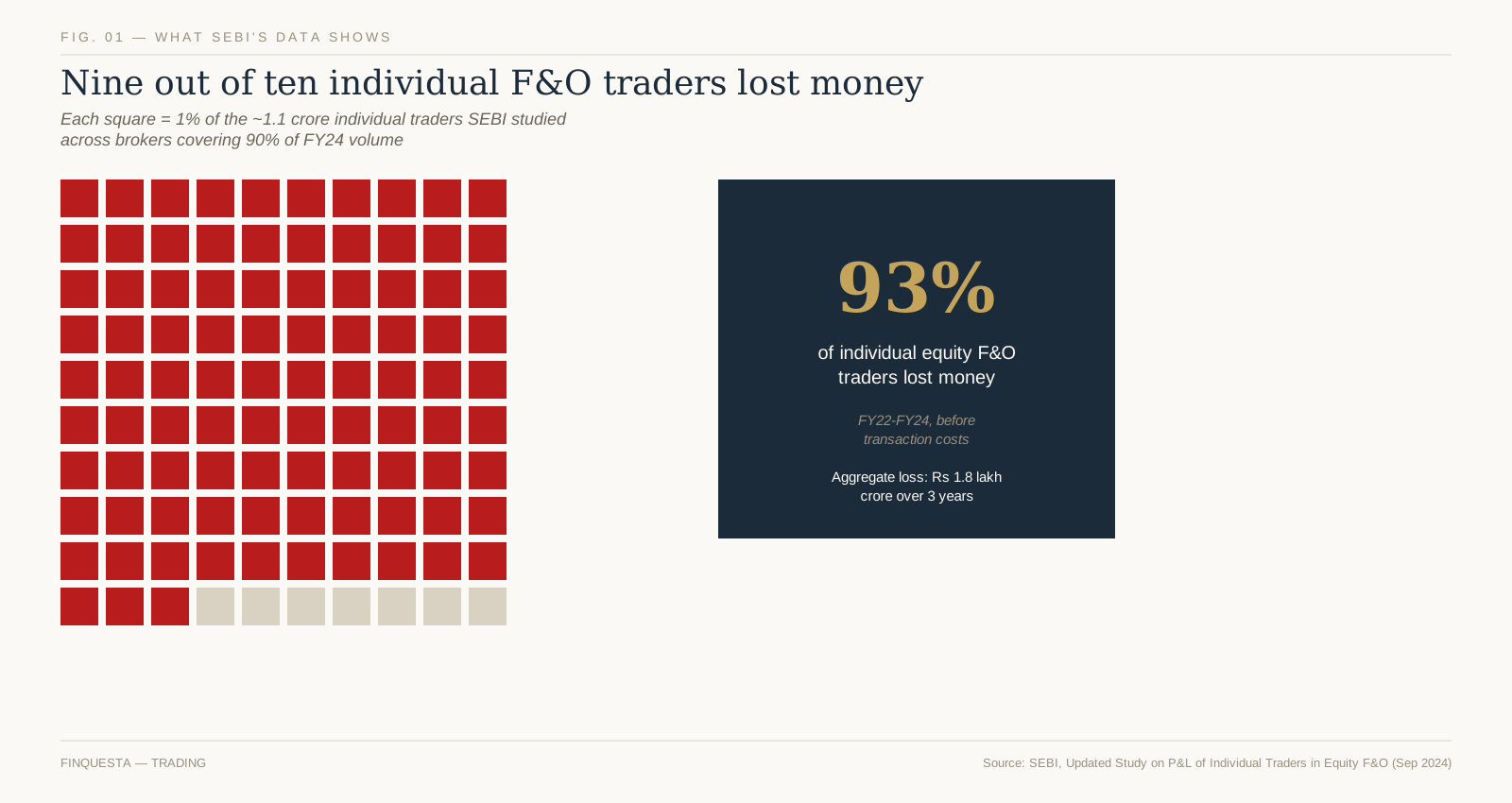
FIG. 01 — 93% of individual equity F&O traders lost money in FY22–FY24, per SEBI’s own study. Source: SEBI, Updated Study on P&L of Individual Traders in Equity F&O (September 2024).
What SEBI’s data actually shows about F&O trading in India
This is the section most F&O explainers skip, and it’s the most important one. SEBI has run two major studies on individual trader outcomes in the equity F&O segment: one published in January 2023 covering FY22, and an updated study in September 2024 covering FY22 through FY24, drawing on data from 15 brokers representing roughly 90% of individual trading volume.
The January 2023 study found that 89% of individual F&O traders lost money in FY22. The September 2024 update found the picture had not improved: 93% of over 1 crore individual traders incurred average losses of about ₹2 lakh each over the three-year period, inclusive of transaction costs. The top 3.5% of loss-makers — roughly 4 lakh traders — lost an average of ₹28 lakh each over the same period. Aggregate losses for individual traders exceeded ₹1.8 lakh crore across the three years [source: SEBI, Updated Study on P&L of Individual Traders in Equity F&O, September 2024].
In sharp contrast, proprietary trading desks and foreign portfolio investors (FPIs) — categories dominated by institutional, algorithm-driven trading — booked gross trading profits of roughly ₹33,000 crore and ₹28,000 crore respectively in FY24 alone, with SEBI noting that the large majority of that profit (96–97%) came specifically from algorithmic execution, not discretionary trading [source: SEBI, Updated Study on P&L of Individual Traders in Equity F&O, September 2024]. The study also found that more than 75% of loss-making individual traders kept trading in F&O despite consecutive years of losses, and that over 75% of individual F&O traders in FY24 had declared annual income under ₹5 lakh.
None of this means F&O trading is impossible to do well — institutions clearly can and do. It means the odds, structurally, favour participants with better data, execution speed and risk systems than most individual retail accounts have access to. That’s a starting fact, not a scare tactic, and it should shape how much capital and confidence any beginner brings to their first trade.
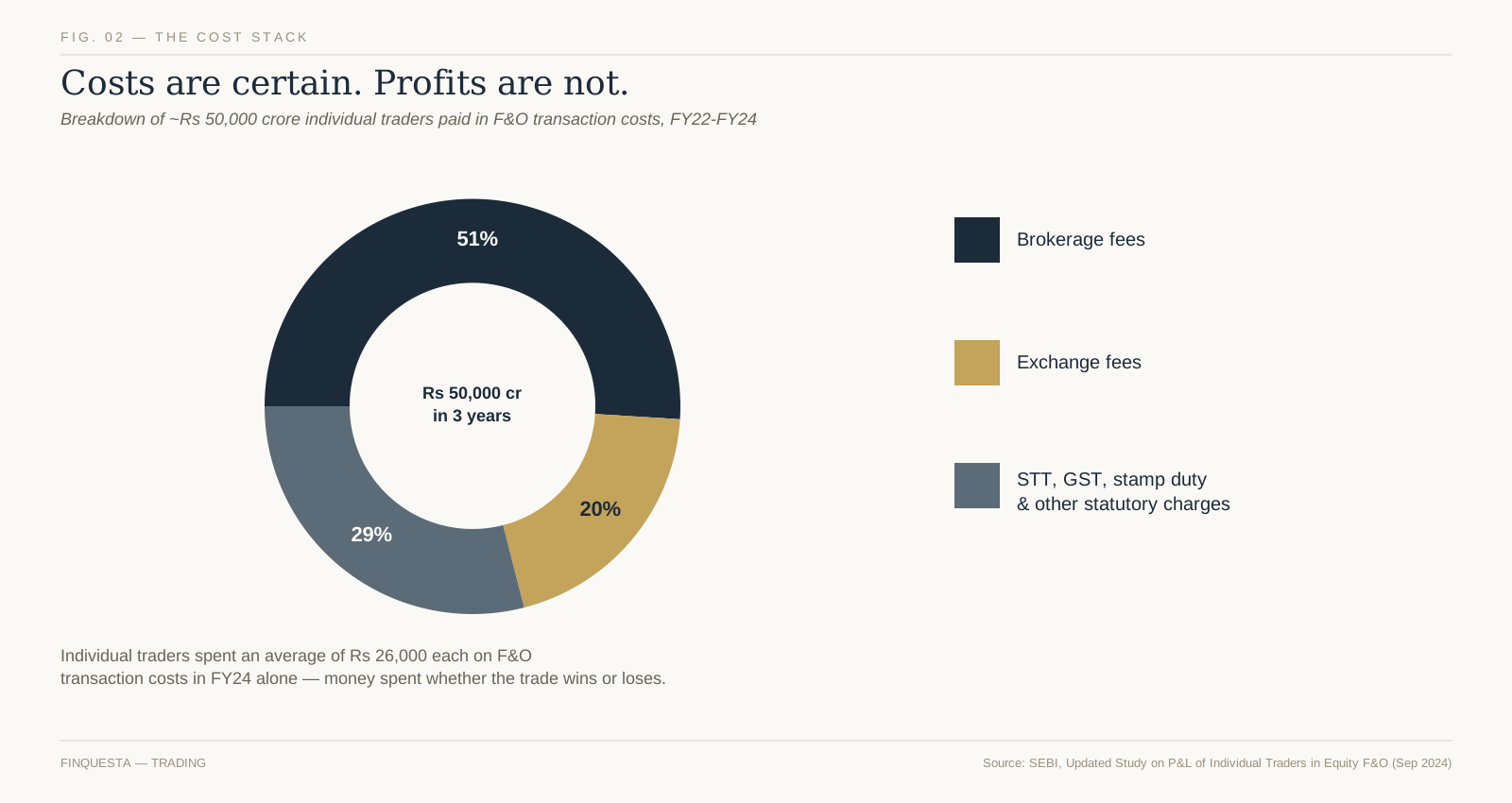
FIG. 02 — Where roughly ₹50,000 crore in individual F&O transaction costs went, FY22–FY24. Source: SEBI, Updated Study on P&L of Individual Traders in Equity F&O (September 2024).
Costs that quietly erode returns
Even a trader who breaks even on price movement can still lose money to costs, because F&O trading involves several charges that apply regardless of outcome. Understanding the full stack matters more here than in long-term investing, because F&O’s shorter holding periods mean costs are paid far more frequently relative to capital deployed.
- Securities Transaction Tax (STT): a direct tax on the sale side of every F&O trade. As per the Union Budget 2026 and effective April 1, 2026, STT on futures is 0.05% of the traded contract value, and STT on options is 0.15% of the premium (and 0.15% on exercise) — both up from the previous rates set in October 2024.
- Brokerage: a flat or percentage fee charged by your broker per executed order, which was the single largest cost component in SEBI’s FY22–FY24 data at roughly 51% of total individual trader transaction costs.
- Exchange transaction charges: fees levied by NSE/BSE on every trade, around 20% of the total cost stack per SEBI’s data.
- GST, SEBI turnover fees and stamp duty: smaller statutory charges applied on top of brokerage and transaction charges, making up the remainder.
SEBI’s study found individual traders spent an average of ₹26,000 each on F&O transaction costs in FY24 alone — money paid out regardless of whether the underlying trade won or lost. Over three years, that added up to roughly ₹50,000 crore across all individual traders combined. A brokerage cost calculator can help you see this stack applied to your own trade size before you place an order.
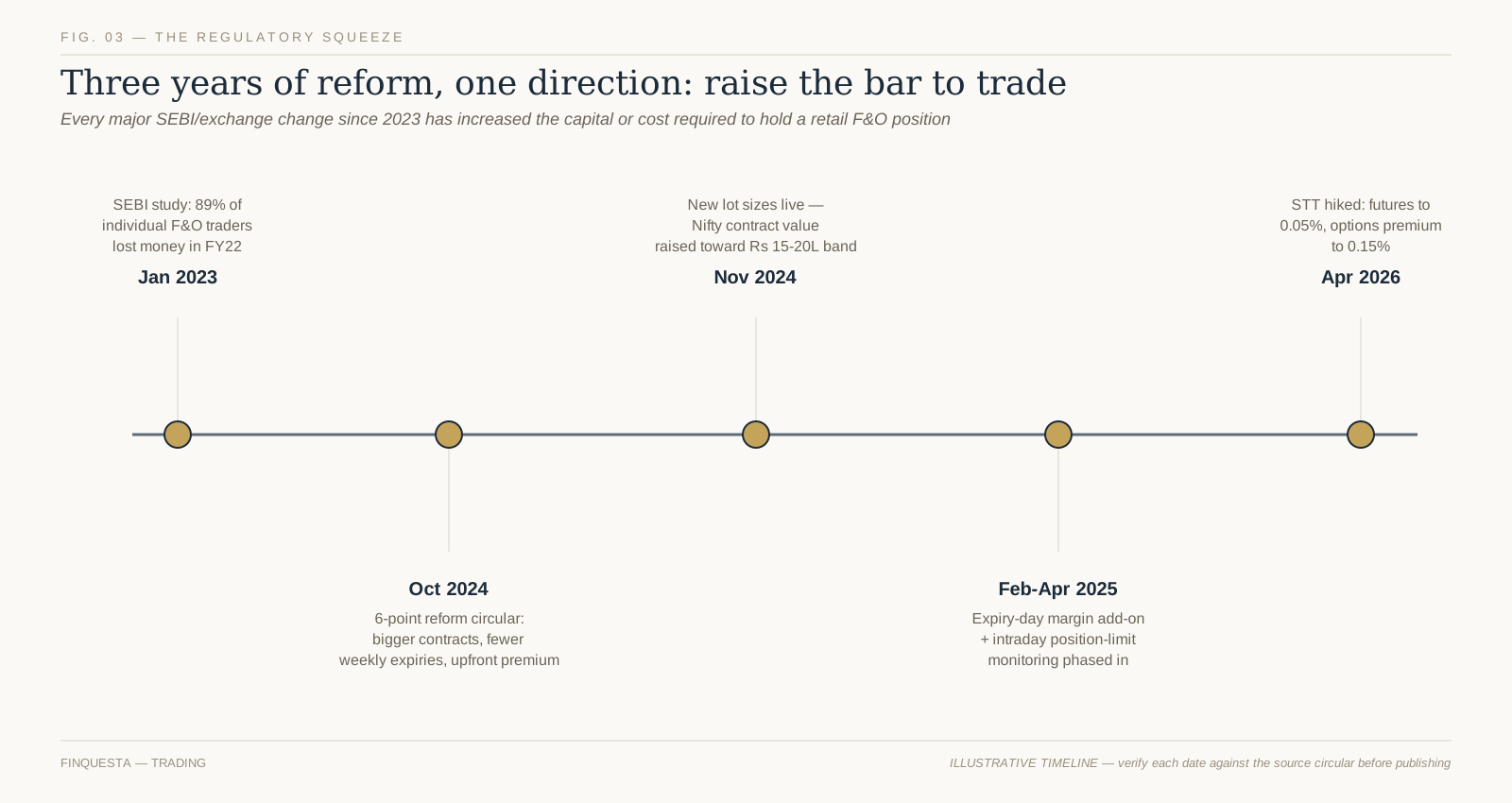
FIG. 03 — Key SEBI/exchange F&O reforms, 2023–2026. Dates and details need confirmation against the original circulars before publishing; see Fact-Check List.
The Contract-Size Squeeze — what the 2024–2026 reforms actually changed
Original Finquesta concept: The Contract-Size Squeeze
Following its loss-rate findings, SEBI introduced a series of reforms through 2024 and 2025 specifically aimed at reducing speculative, low-probability trading by individual participants, and the Union Budget 2026 added a further cost-side change on top. Taken together :
- Contract value raised: the minimum value of a new index derivative contract was raised from roughly ₹5–10 lakh to a ₹15–20 lakh band — the first such revision in nine years — which pushed lot sizes higher (for example, Nifty’s lot size rose from 25 to 75 units in the November–December 2024 transition).
- Weekly expiries rationalised: exchanges were limited to offering weekly expiry contracts on only one benchmark index each, ending the previous situation where several indices expired on different days of the same week.
- Extra margin near expiry: an additional Extreme Loss Margin now applies to index derivative positions on their expiry day, when historical volatility — and retail losses — have been highest.
- Upfront premium collection and tighter position monitoring: option buyers must pay their full premium upfront (removing a leverage loophole), and exchanges now monitor position limits intraday rather than only at day’s end, phased in through April 2025.
- STT increase: effective April 1, 2026, the Union Budget raised STT on futures and options, adding a further cost-side deterrent on top of the volume-side changes above.
The name for this pattern — The Contract-Size Squeeze — describes what these changes mean in practice for a retail account with a fixed amount of capital: instead of spreading that capital across several smaller positions, a trader is now pushed toward fewer, larger, more concentrated ones simply to meet the new minimum contract values. The stated intent was to raise the bar to trading altogether; one side effect is that the trades an under-capitalised account can still afford are now bigger relative to that account, not smaller — which is worth understanding before assuming “SEBI made it safer” means “my trade is now lower-risk.” Read our full breakdown of how SEBI’s margin framework applies contract-by-contract.
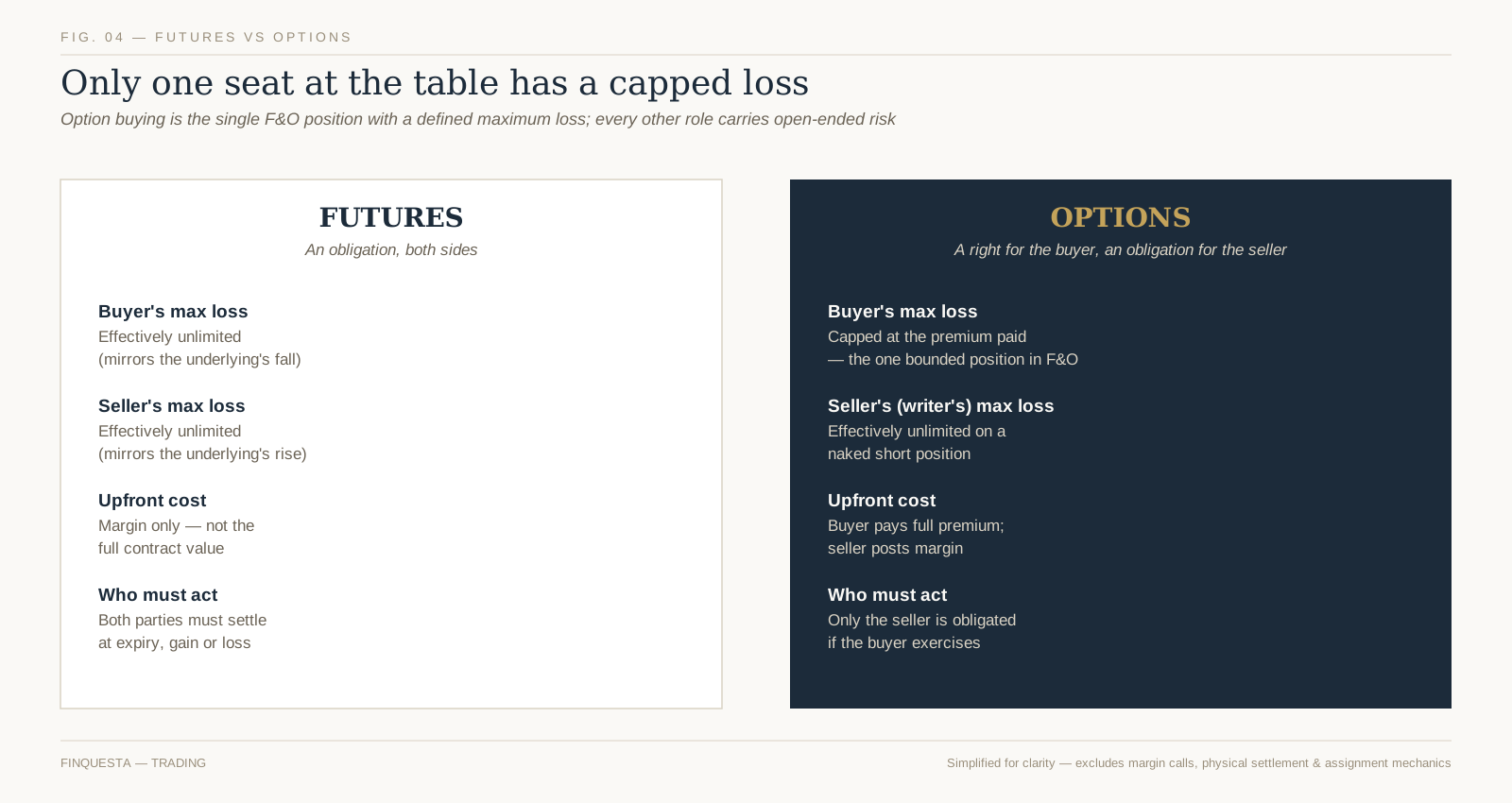
FIG. 04 — Simplified comparison of maximum loss by position type. Excludes margin calls, physical settlement and assignment mechanics.
Futures vs options — how the risk profile really differs
The two instruments are often bundled together as “F&O,” but they carry meaningfully different risk shapes, and the difference matters more than most beginner guides let on.
A futures position — long or short — has, in practical terms, open-ended risk in both directions: a buyer’s loss grows as the underlying falls, a seller’s loss grows as it rises, and neither side has a built-in cap. An options buyer is the one position in the entire F&O universe with a genuinely bounded maximum loss: the premium paid, and nothing more, because the buyer can simply choose not to exercise a contract that has moved against them. An options seller, by contrast, takes on the mirror image — collecting a limited, known premium in exchange for open-ended obligation risk if the position moves sharply against them, particularly on uncovered (“naked”) positions.
This is why “I’m just buying an option, so my risk is limited” is true in isolation but incomplete in practice — the Premium Illusion covered earlier explains why a capped-but-likely loss can still be a poor trade, and why a trader who moves from buying options to selling them is taking on a materially different, larger-tailed risk, even though the premium collected looks like “free money” upfront.
Common F&O strategies beginners hear about
Beyond outright buying or selling a single contract, traders combine futures and options into structured positions. These are explained here for what they mechanically are, not as a recommendation to use any of them — each carries its own risk profile, cost structure and margin requirement, and suitability depends entirely on an individual’s capital, risk tolerance and market view.
- Covered call: an investor who already holds the underlying shares sells a call option against them, collecting the premium as extra income, in exchange for capping their potential upside if the stock rallies past the strike.
- Protective put: an investor holding shares buys a put option as insurance against a decline — similar in spirit to Suresh’s hedge earlier in this guide — paying a premium for downside protection.
- Spreads (e.g., bull call spread, bear put spread): buying one option and simultaneously selling another at a different strike, which typically reduces both the cost of the position and its maximum profit potential, while also capping the maximum loss compared to an outright naked position.
Every one of these still carries the underlying dynamics covered above — margin, time decay, and transaction costs on each leg of the trade. A three-leg spread pays transaction costs three times over, which is worth factoring in before assuming a “hedged” strategy is automatically a low-cost one.
Taxation of F&O trading in India
Under Indian income tax law, profit or loss from F&O trading is treated as non-speculative business income, not capital gains — a distinction that surprises many beginners who assume it would be taxed like equity delivery trades. This means F&O income is added to your other income and taxed at your applicable income tax slab rate, and it must be reported using ITR-3, not the simpler ITR-1 or ITR-2 forms used for salary or capital-gains-only filers.
Turnover for F&O trading, for tax purposes, is calculated as the absolute sum of all profits and losses across trades — not net profit — which means a trader with many small wins and losses can cross a tax-audit turnover threshold even with a modest net result. Whether a tax audit is required depends on this computed turnover relative to limits set under the Income Tax Act, which are periodically revised.
This section is general information, not tax advice specific to your situation — F&O tax treatment has enough moving parts (turnover computation, audit thresholds, presumptive taxation eligibility) that a chartered accountant familiar with trading income is worth consulting before filing, especially in your first year of F&O activity.
Who should — and shouldn’t — trade F&O
This isn’t a recommendation either way; it’s a framework for the questions worth asking honestly before your first trade.
- Capital you can lose without consequence: given SEBI’s data on how often individual traders lose, and given the raised contract-value minimums since 2024, F&O now requires meaningfully more capital per position than it did two years ago. Money needed for near-term expenses or emergencies doesn’t belong here.
- A specific view or a specific risk to hedge: the clearest, most defensible use cases in SEBI’s own framing are hedging an existing position (like Suresh) or acting on a well-researched, time-bound view — not habitual, undirected trading.
- Willingness to track a position daily: unlike a long-term equity or mutual fund holding, an open F&O position — especially near expiry — can require active daily attention because of mark-to-market settlement and time decay.
- Honest accounting for costs, not just price moves: as Figure 2 shows, costs are certain and payable regardless of outcome. A trading plan that only models price direction, and ignores STT, brokerage and exchange charges, is modelling an incomplete picture.
If most of these don’t clearly apply to you yet, that’s useful information, not a verdict — building market experience through smaller, longer-horizon instruments first is a legitimate path toward F&O, not a consolation prize.
Before you place your first F&O trade
- Read your broker’s risk disclosure document in full — SEBI requires brokers to provide this before enabling F&O trading on your account, and it’s written specifically to cover the mechanics this guide has walked through.
- Calculate your actual margin requirement and worst-case loss for the specific contract and lot size you’re considering, using your broker’s margin calculator — not a rough estimate.
- Total the full cost stack — STT, brokerage, exchange charges, GST — for your position size before placing the trade, not after.
- Decide your exit plan (both profit-taking and loss-limiting) before you enter the trade, not while you’re watching the position move.
- Start with position sizes small enough that the raised, post-2024 lot sizes don’t push you into a single trade that represents an outsized share of your total trading capital.
Frequently asked questions
What is F&O trading in simple terms?
F&O trading means buying and selling futures and options contracts — agreements whose value is based on an underlying stock or index. A futures contract obligates both sides to transact at a set price on a set date; an options contract gives the buyer the right, but not the obligation, to do so, for a premium paid to the seller.
Is F&O trading safe?
F&O trading carries substantially higher risk than long-term equity or mutual fund investing, largely because of leverage, time decay on options, and short holding periods. SEBI’s own study found 93% of individual F&O traders lost money over FY22–FY24. It isn’t inherently “unsafe” as a tool — institutions use it for hedging every day — but for most individual retail traders, the historical outcomes have skewed heavily toward losses.
Can I lose more than my capital in F&O trading?
It depends on the position. An options buyer’s maximum loss is capped at the premium paid — they cannot lose more than that. A futures position (long or short) or an options-selling position, however, carries open-ended risk that can, in volatile conditions, exceed the margin initially posted, potentially triggering a margin call for additional funds.
What is the difference between futures and options?
A futures contract is a mutual obligation — both the buyer and seller must transact at the agreed price on the expiry date. An options contract gives only the buyer a right, which they can choose not to exercise, while the seller remains obligated if the buyer does exercise. This is why futures carry open-ended risk on both sides, while an options buyer’s risk is capped at the premium paid.
Futures vs options — which is riskier?
It depends on which side of the trade you’re on. Buying an option is the one F&O position with a defined maximum loss (the premium). Selling an option, or taking either side of a futures contract, carries open-ended risk. So “futures vs options” isn’t a single riskier-or-safer comparison — it’s really four distinct risk profiles: futures buyer, futures seller, options buyer, and options seller.
How much capital do I need to start F&O trading?
This depends on the specific contract, its current lot size, and the prevailing margin requirement, all of which change periodically — index contract minimum values were raised to a ₹15–20 lakh band from November 2024, pushing typical lot sizes and margin requirements higher than they were previously.
Is F&O trading considered gambling?
Legally and structurally, no — F&O contracts are regulated financial derivatives with legitimate hedging uses, unlike gambling. Behaviourally, SEBI’s own data raises the concern directly: the regulator found that over 75% of individual traders who lost money in F&O kept trading despite consecutive years of losses, a pattern that overlaps with how compulsive, high-frequency betting behaviour is often described, even though the underlying instrument is a legitimate one.
How is F&O trading taxed in India?
F&O profit or loss is treated as non-speculative business income under Indian tax law, added to your other income and taxed at your income tax slab rate, and reported via ITR-3. Turnover for audit purposes is calculated as the absolute sum of profits and losses across trades, not the net result.
| Disclaimer This article is for informational and educational purposes only and does not constitute financial, investment, tax, or legal advice. Figures, rates, and regulations mentioned are subject to change; please verify current details with official sources (RBI, SEBI, the Income Tax Department, IRS, or a licensed financial advisor) before making financial decisions. Finquesta may earn a commission from affiliate links in this article at no extra cost to you. |