
Compound interest is what happens when the interest your money earns starts earning interest of its own, instead of being paid out separately. Anyone with a savings account, fixed deposit, PPF account, mutual fund, or retirement account is already using it, knowingly or not — and anyone carrying a credit card or loan balance is subject to the exact same mechanism in reverse. There’s no minimum amount needed for it to work; it applies to ₹500 exactly as it applies to ₹50 lakh. What changes the outcome isn’t the starting amount — it’s the rate, the frequency, and above all, the time you leave it alone.
Table of Contents
What Compound Interest Really Means
Most people meet compound interest for the first time through a credit card statement, not a retirement calculator.
You carry forward a balance one month. The next bill is a little higher than what you spent — not just because of new purchases, but because of what you already owed. Leave it a few months longer and the growth isn’t steady anymore; it’s accelerating. A ₹50,000 balance at a fairly typical Indian credit card rate of 36% a year, compounding monthly with no payments at all, would grow past ₹1,00,000 in well under two years. That’s the same mechanism, working in the direction most of us meet it first.
Compound interest, explained without the mythology: your money earns a return, that return gets added to your balance, and the next round of earnings is calculated on the new, larger total. That’s it. Everything else in this guide — the formula, why growth feels slow at first, where compounding actually shows up in your accounts, and where it quietly works against you — is just that one idea, followed through to its real consequences.
In the direction that builds wealth instead of debt, compound interest is simply this: the interest your money earns doesn’t sit off to the side. It gets folded back into the balance, and the next round of interest is calculated on the new, larger number. Then that happens again. And again. Every cycle, the base gets a little bigger, so every subsequent round of interest is calculated on more than the round before it.
You’ll often see this called “the eighth wonder of the world,” usually attributed to Einstein. It’s worth being precise about that, because Finquesta would rather lose a good line than repeat a bad citation: there’s no verified record Einstein ever said it.
Quote Investigator, the reference project that traces misattributed quotations back to their source, found the earliest print appearance in unsigned 1920s bank advertising copy, with the specific Einstein attribution not showing up until 1983 — 28 years after his death, with no citation attached. Princeton’s own edited volume of his quotes files it under “Probably Not By Einstein.”
None of that makes the underlying math less real. It just means you don’t need a borrowed authority to make the point — the numbers do that on their own.
Simple Interest vs. Compound Interest: The Difference That Compounds
Here’s the comparison that actually explains why compounding matters, using a single lump sum so the two methods are directly comparable: ₹1,00,000, at an assumed 8% a year, for 30 years.
Under simple interest, you earn 8% of the original ₹1,00,000 every single year — always ₹8,000, no matter how long the money has been sitting there. After 30 years, that’s ₹1,00,000 principal plus 30 × ₹8,000, or ₹3,40,000 total.
Under compound interest, each year’s 8% is calculated on the current balance, not the original one. Year one looks almost identical to simple interest — ₹1,08,000 either way. By year ten, compound interest has pulled ahead to roughly ₹2.16 lakh against simple interest’s ₹1.8 lakh. By year thirty, compound interest has grown to just over ₹10 lakh — nearly three times what simple interest produced from the exact same starting amount and the exact same rate.
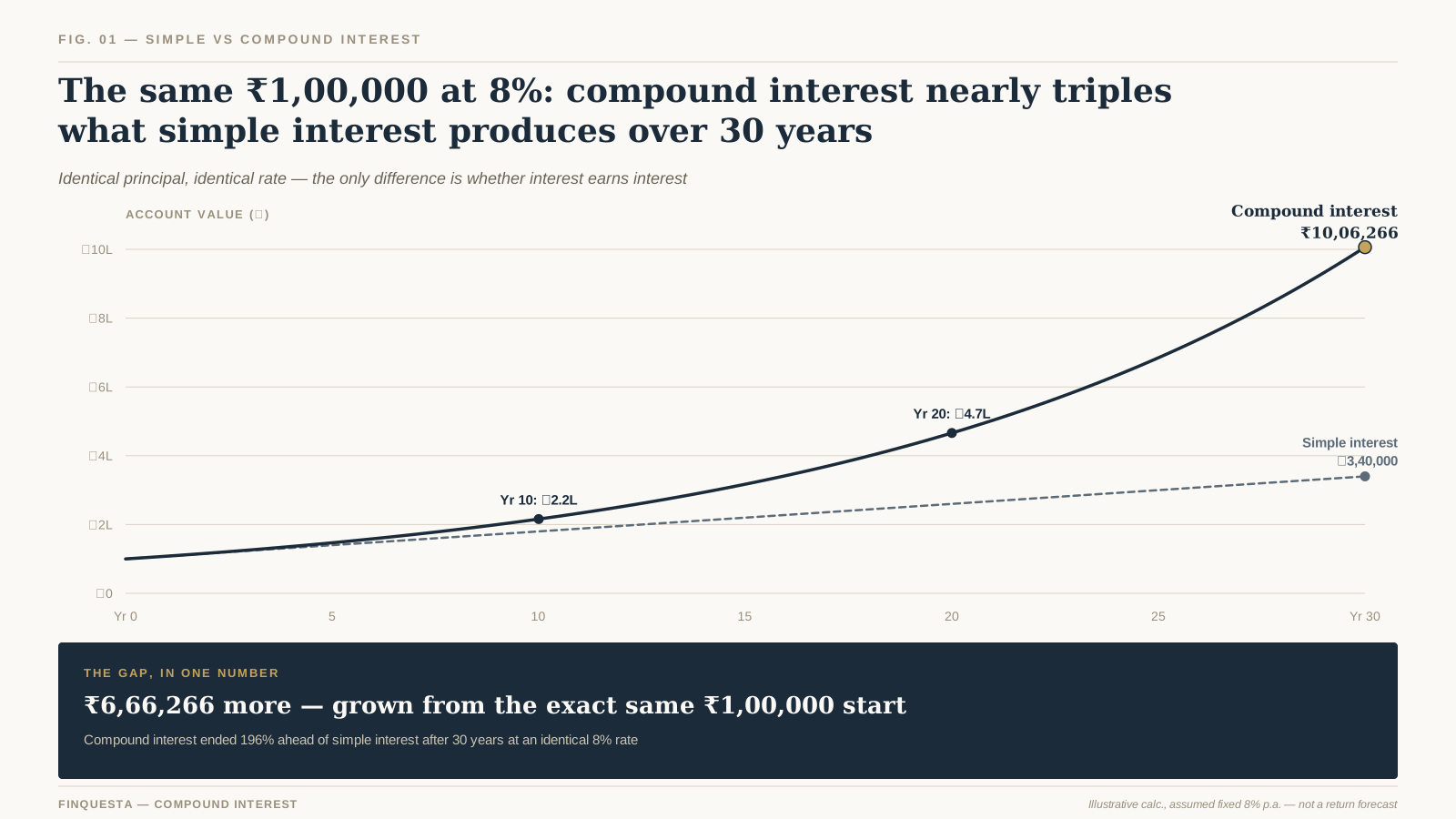
FIG. 01 — Simple vs compound growth of the same ₹1,00,000 over 30 years at an assumed 8% p.a.
Nothing changed except how the interest was treated. That gap — roughly ₹6.66 lakh on a ₹1 lakh starting point — is the entire argument for compound interest in one comparison.
The Compound Interest Formula, Broken Down
The standard formula looks intimidating until you see what each piece is actually doing:
A = P (1 + r/n)^(nt)
- A is the amount you end up with
- P is your principal — what you start with
- r is the annual interest rate, written as a decimal (8% becomes 0.08)
- n is how many times per year the interest compounds (1 for annual, 12 for monthly, 365 for daily)
- t is the number of years you leave it invested
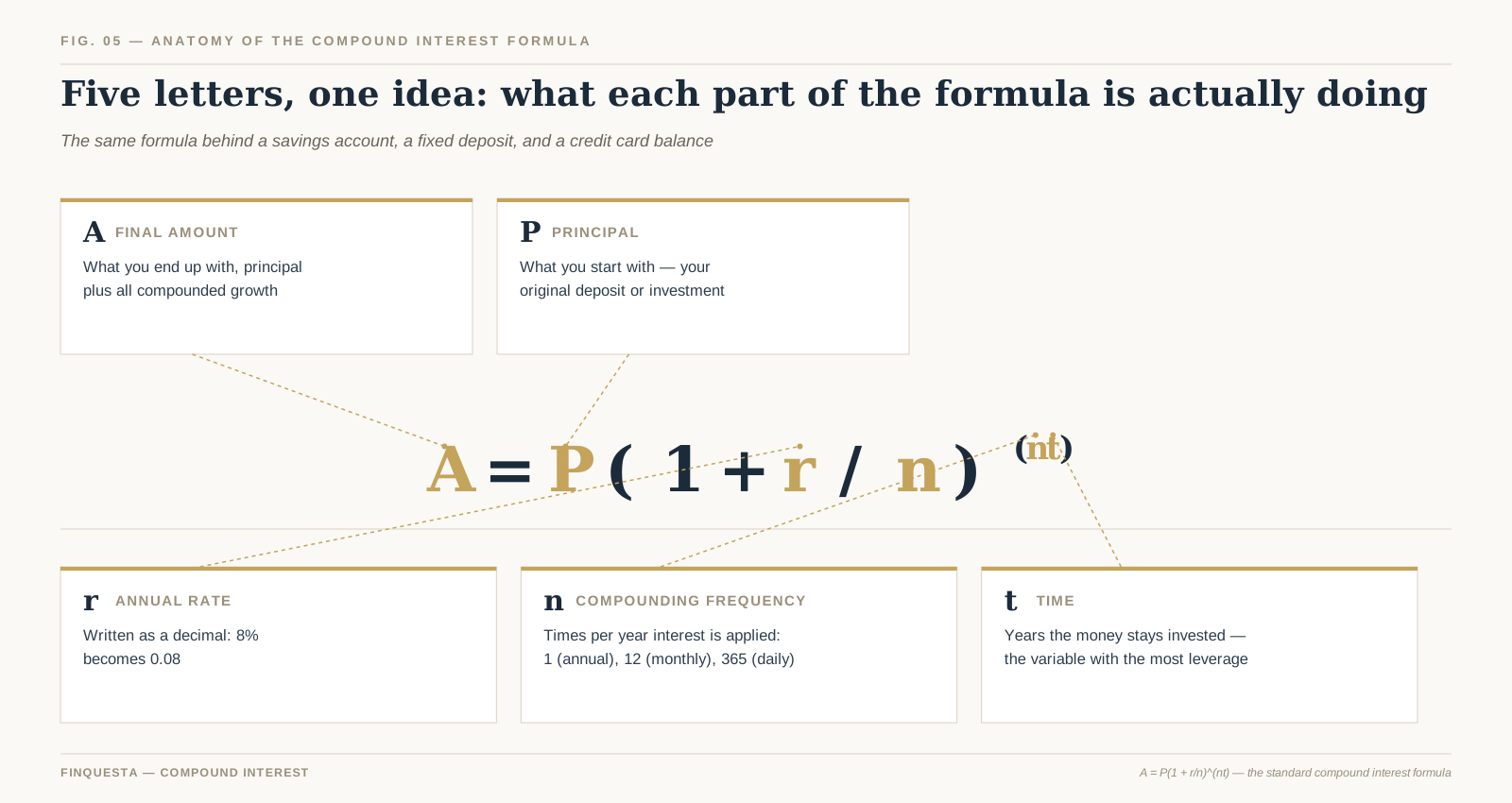
FIG. 05 — Anatomy of the compound interest formula: A = P(1 + r/n)^(nt)
If you’re contributing regularly instead of depositing one lump sum — a monthly SIP, a recurring deposit, a salary-linked retirement contribution — the formula changes shape slightly (it becomes a future-value-of-annuity calculation), but the underlying logic doesn’t change at all: each contribution starts compounding from the day it lands, so your earliest contributions do disproportionately more work than your most recent ones, simply because they’ve had longer to compound. That single fact is the reason the next two sections exist.
Why Compounding Feels Slow at First: The Quiet Decade
ORIGINAL FINQUESTA FRAMEWORK
Take a fairly ordinary example: investing ₹10,000 every month at an assumed 12% average annual return — a commonly used long-term assumption for diversified equity investing in India, though real returns will vary year to year and are never guaranteed. Run that for 30 years and look at what the growth (not the contributions — the growth alone) looks like, broken into three ten-year blocks:
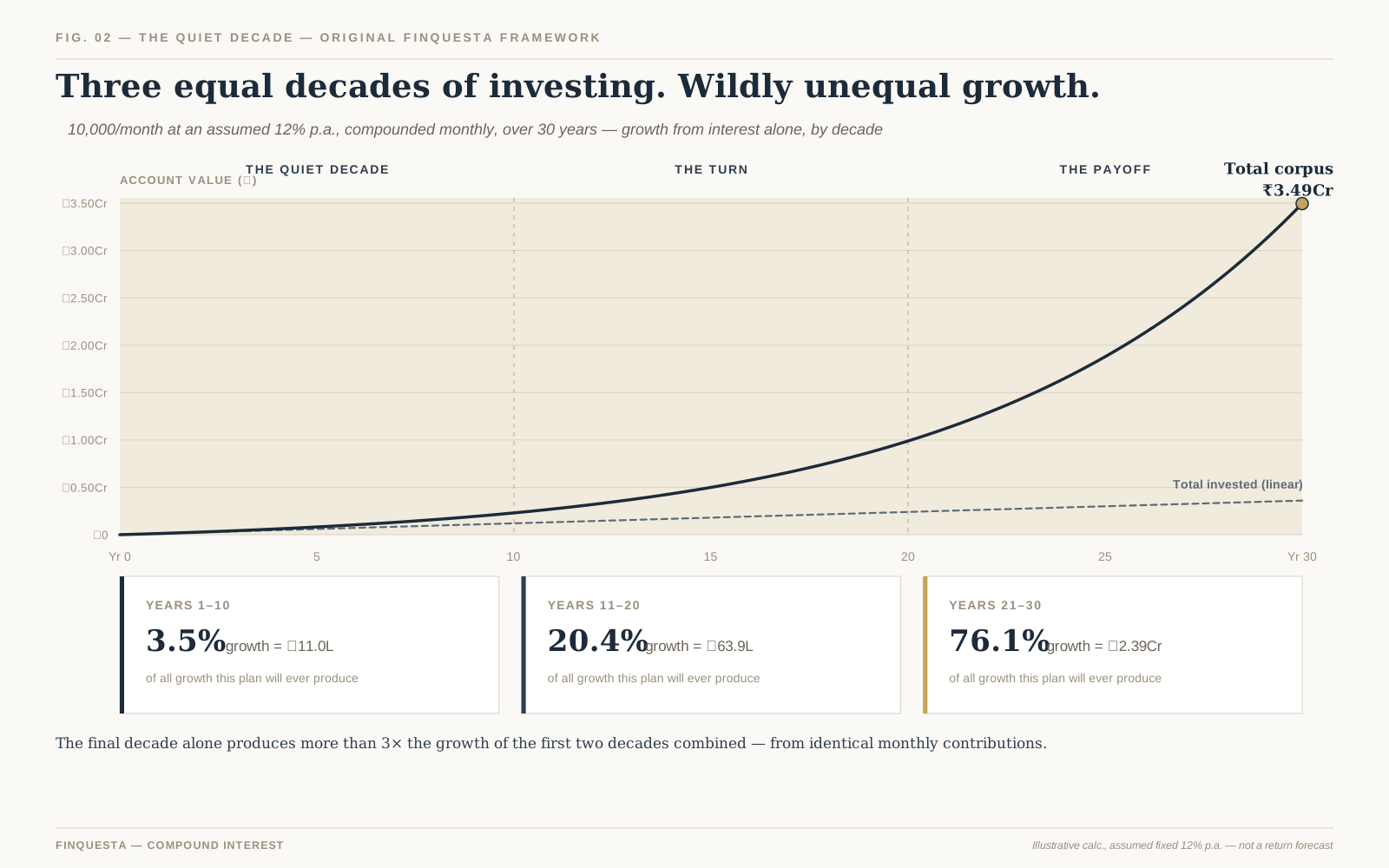
FIG. 02 — The Quiet Decade: growth by decade on a ₹10,000/month SIP at an assumed 12% p.a. (Original Finquesta framework)
- Years 1–10: you’ve put in ₹12 lakh. The account has grown to about ₹23 lakh. Growth from interest alone: roughly ₹11 lakh — about 3.5% of the growth this plan will eventually produce.
- Years 11–20: same monthly amount, same rate. Growth from interest alone in this decade: roughly ₹63.9 lakh — about 20.4% of total lifetime growth.
- Years 21–30: growth from interest alone in this final decade: roughly ₹2.39 crore — about 76.1% of everything this plan will ever earn.
Three equal ten-year stretches. Identical monthly contribution. Identical assumed rate. And the last one does more than three times the work of the first two combined.
We call the first stretch the Quiet Decade — not because nothing is happening (the math is working exactly as designed, every single month), but because almost nothing is visible yet. A chart of this account over its first ten years looks close to a straight line. It’s only once you’re well into the second decade that the curve starts to visibly bend upward, and only in the third decade that it becomes the dramatic, headline-friendly hockey stick every finance article likes to show you.
This is, as far as we can tell, the actual reason most people quit long-term investing early rather than because the maths stopped working: the first several years genuinely do look unimpressive next to the amount you’re putting in, and there’s no visual cue telling you the shape is about to change. If you know the Quiet Decade is coming, you can recognise it for what it is — the unglamorous, unavoidable setup phase — instead of mistaking it for the plan not working.
This is also the direct, quantified answer to a question that comes up constantly: does starting five years late really cost that much? Using the exact numbers above: someone who starts this plan on time reaches roughly ₹3.49 crore at year 30. Someone who starts five years late — same monthly amount, same rate, just beginning at what would have been year six — is only 25 years into their own timeline by that same calendar point, with a corpus of roughly ₹1.88 crore. A five-year delay, on total contributions that differ by only ₹6 lakh, produces a final-corpus gap of roughly ₹1.62 crore — because those five lost years weren’t just five years of missed contributions, they were five years removed from the most productive end of the curve, not the flattest end.
The Crossover Point: When Growth Starts Outpacing Your Own Contributions
ORIGINAL FINQUESTA FRAMEWORK
Here’s a more useful milestone than “the earlier the better,” because it’s specific enough to actually calculate for your own numbers.
Using the same ₹10,000-a-month, 12%-assumed example: for the first several years, whatever you contribute in a given year is larger than whatever the account earns in that same year. You are still doing more work than your money is. Then, at a specific point, that flips — the growth earned in a single year becomes larger than the amount you contributed that year, and from then on, the gap keeps widening in your favour every year that follows.
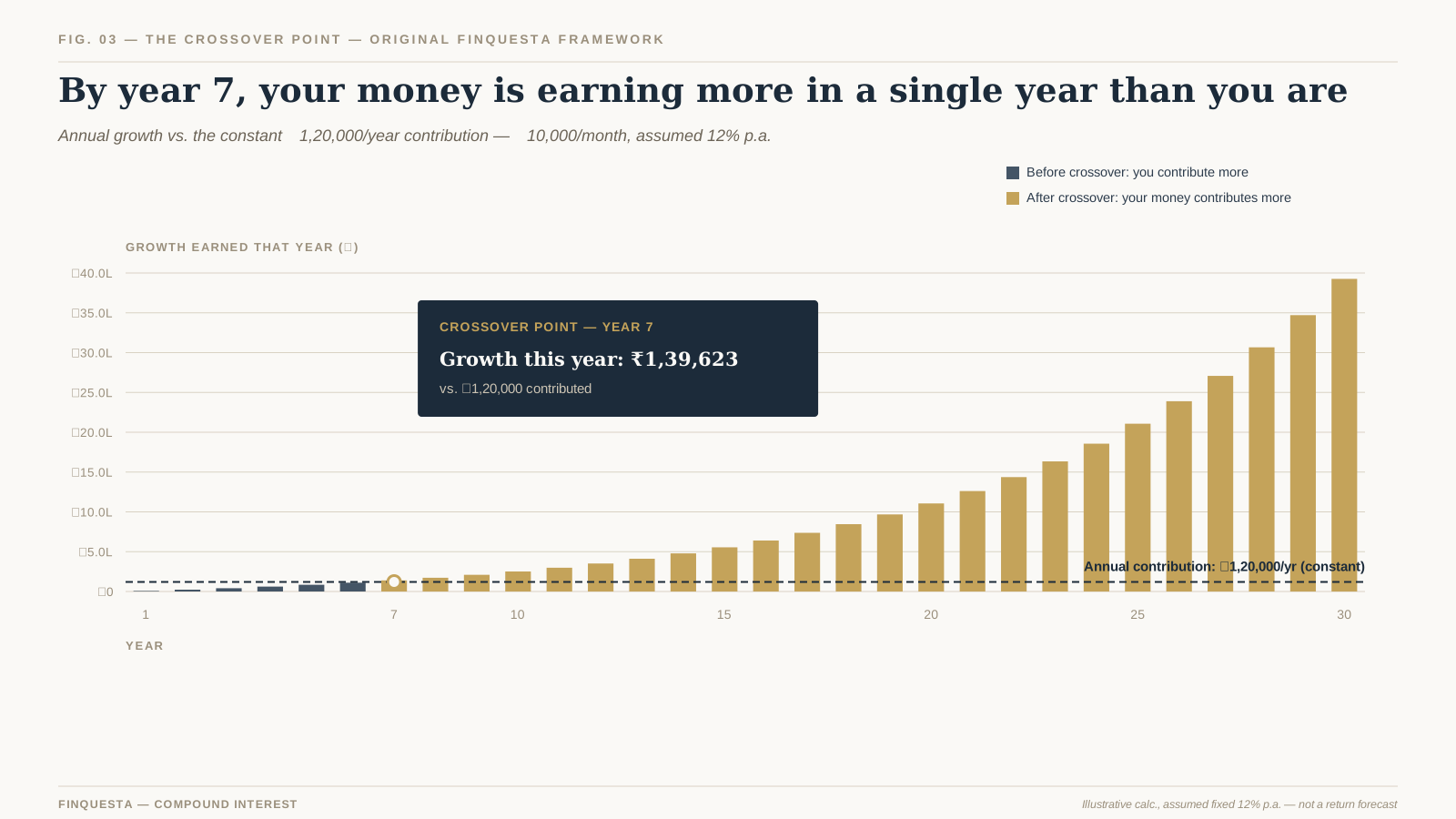
FIG. 03 — The Crossover Point: annual growth overtakes the annual contribution in year 7 (Original Finquesta framework)
In this example, that point arrives in year 7: the account earns roughly ₹1,39,600 in growth during year 7 alone, against ₹1,20,000 contributed that year. From year 7 onward, your money is contributing more than you are, every single year, by a growing margin.
We call this the Crossover Point, and unlike “start early,” it isn’t just encouragement — it’s a specific, calculable year that changes based on your own contribution amount and assumed rate. A higher assumed return or a smaller monthly contribution pulls the Crossover Point closer; a lower rate or a larger monthly amount pushes it further out. Either way, it turns an abstract concept into a real date on a real calendar you can actually look forward to, which tends to matter more for staying consistent through the Quiet Decade than any encouragement to “just be patient” ever does.
Does Compounding Frequency Actually Matter?
Every compound interest article mentions that more frequent compounding — monthly instead of annual, daily instead of monthly — produces a larger final number. That’s true. What’s less often shown is how much larger, because the honest answer undercuts the drama.
Take ₹1,00,000 at an assumed 8% annual rate for 20 years:
| Compounding frequency | Final amount | Differen Zce vs. annual |
| Annual | ₹4,66,096 | — |
| Monthly | ₹4,92,680 | +₹26,584 (5.7%) |
| Daily | ₹4,95,216 | +₹29,121 (6.2%) |
Monthly versus daily — the two frequencies most often compared in marketing material — differ by about ₹2,536 over 20 years on a ₹1 lakh base, or roughly 0.5%. Frequency matters, and it’s a real, mathematically legitimate reason to prefer an account that compounds more often, all else equal. But it is a rounding error next to the two variables that actually move the outcome: the rate you’re earning, and the time you stay invested. If a bank’s pitch leans heavily on “daily compounding” as the headline reason to choose it over a comparable option with a better rate, the frequency isn’t the thing worth chasing.
The Rule of 72: A Shortcut, Not a Substitute
The Rule of 72 estimates how many years it takes an amount to double: divide 72 by the annual interest rate. At 8%, that’s 72 ÷ 8 = 9 years. It’s a genuinely useful mental-math shortcut — but it’s an approximation, and it’s worth knowing exactly where it holds up and where it starts to drift, rather than treating it as exact in every context.
| Rate | Rule of 72 estimate | Actual doubling time |
| 6% | 12.00 years | 11.90 years |
| 7.1% (PPF, current rate) | 10.14 years | 10.11 years |
| 8% | 9.00 years | 9.01 years |
| 12% | 6.00 years | 6.12 years |
| 18% | 4.00 years | 4.19 years |
| 36% (typical Indian credit card rate) | 2.00 years | 2.25 years |
The rule is nearly exact in the 6–10% range — which happens to be roughly where long-term fixed-income and blended equity-debt returns tend to sit, which is probably why the rule became popular in the first place. Above about 15%, it starts understating the real doubling time, and the gap widens as the rate climbs. At credit-card-level rates, the Rule of 72 tells you your debt doubles in 2 years when the real figure is closer to 2.25 — a meaningful understatement exactly where getting it wrong costs you the most.
When Compound Interest Works Against You: Debt
Every mechanism described so far runs identically in reverse. A credit card issuer isn’t doing anything mathematically different from a bank paying you interest — they’re applying the same formula, with you on the other side of it.
At a representative Indian credit card rate of 36% a year, compounded monthly, an untouched ₹50,000 balance — assuming genuinely no payments are made at all, which is a worst-case illustration, not a typical outcome — grows past ₹1,00,000 in about 23 months, under two years. Real cards require a minimum payment each month, which slows this considerably, but paying only the minimum still leaves the bulk of the balance compounding against you month after month — which is precisely why minimum-payment-only debt is so difficult to work down even when the monthly payment feels manageable.
This is the same mechanism from the earlier sections, in a mirror. The Quiet Decade and the Crossover Point both describe compounding working slowly in your favour, then accelerating. Debt compounds on exactly the same schedule — slowly at first, then faster — except every month it isn’t paid down is a month working against you instead of for you. Understanding the mechanism is what makes the difference obvious: the goal isn’t to fear compound interest, it’s to make sure you’re consistently on the side of it that’s working for you.
The Tax Leak: How Taxation Quietly Slows Down Compounding
ORIGINAL FINQUESTA FRAMEWORK
Almost no beginner explanation of compound interest accounts for tax — but tax changes the compounding math directly, because money paid out in tax each year is money that stops compounding from that point forward.
Compare two ₹1,00,000 deposits, both earning an identical 7.1% a year (the current PPF rate — see below), over 20 years. One compounds completely untouched. The other has its interest taxed away annually at a 30% slab rate, the way a taxable fixed deposit’s interest is treated in India, before the balance is allowed to keep growing.
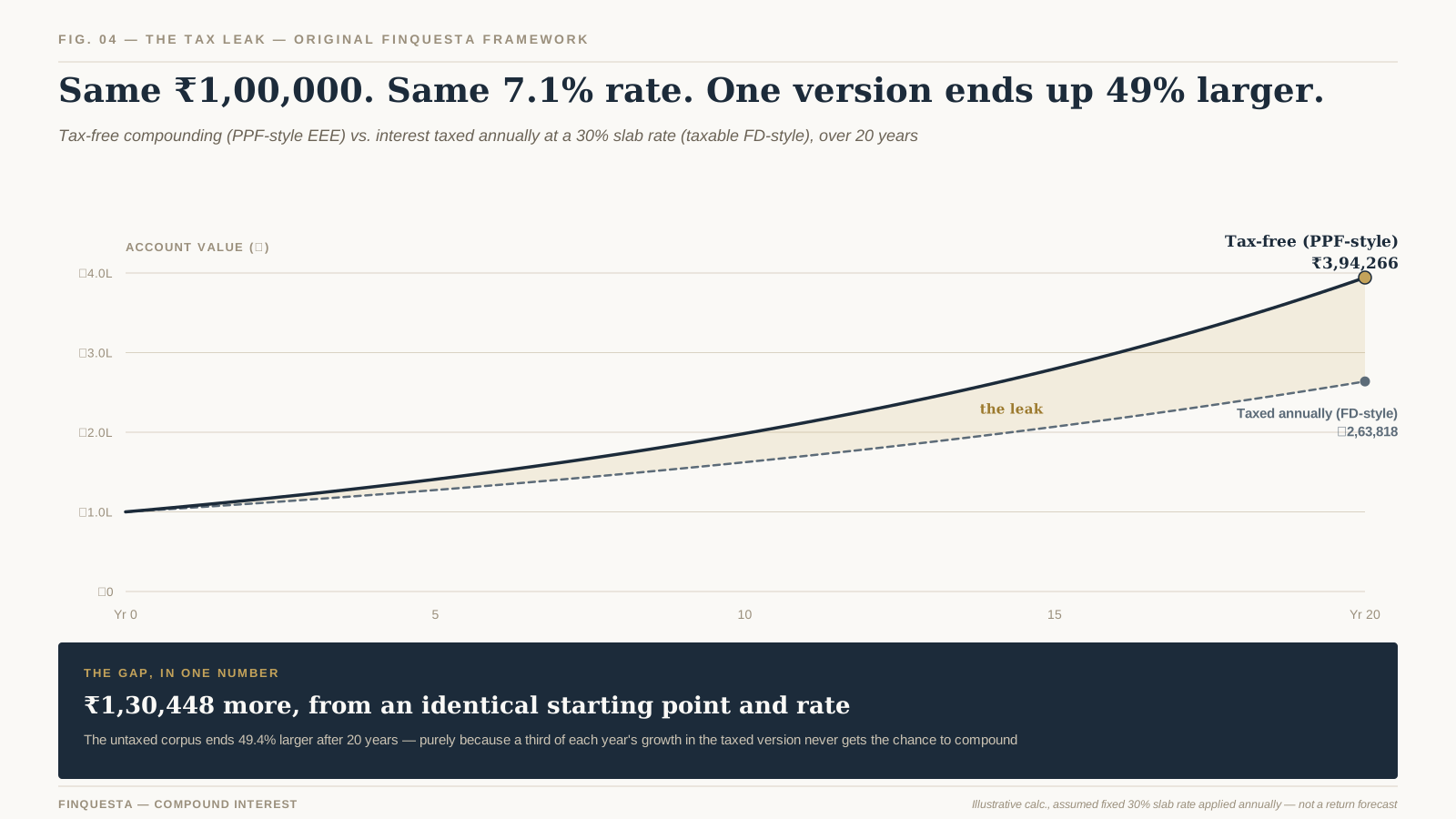
FIG. 04 — The Tax Leak: identical 7.1% rate, tax-free vs. taxed annually at a 30% slab rate (Original Finquesta framework)
| Untaxed (compounds fully) | Taxed annually at 30% | |
| Year 5 | ₹1,40,912 | ₹1,27,446 |
| Year 10 | ₹1,98,561 | ₹1,62,425 |
| Year 15 | ₹2,79,796 | ₹2,07,004 |
| Year 20 | ₹3,94,266 | ₹2,63,818 |
Same starting amount. Same headline rate. A ₹1,30,448 gap after 20 years — the untaxed corpus ends up 49.4% larger — purely because one version keeps compounding on its full interest and the other has a third of each year’s growth quietly removed before it gets the chance to compound.
This is precisely why India’s EEE (exempt-exempt-exempt) instruments — PPF being the clearest example — are structurally different from a taxable fixed deposit paying a similar headline rate. It isn’t only that PPF is government-backed; it’s that a taxable FD’s real, compounding rate is quietly lower than its advertised rate for anyone in a taxable bracket, every single year, while an EEE instrument compounds on its full, undiminished rate for the entire holding period.
Real Returns vs. Nominal Returns: What Inflation Quietly Takes Back
There’s a second leak that works the same way as tax, and it’s just as easy to miss: inflation.
If your investment grows at 8% a year and inflation runs at 5% a year, your money isn’t really compounding at 8% in terms of what it can actually buy — it’s compounding at closer to 3% in real terms (the precise calculation is (1.08/1.05) − 1 ≈ 2.86%, not a simple 8% − 5% subtraction, though the subtraction is a reasonable quick approximation at low rates). This matters most for anything held for decades, since a rate that comfortably beats inflation in year one can quietly stop doing so if inflation rises and the nominal rate doesn’t. A fixed deposit paying 7% during a period when inflation is running at 7% isn’t growing your money in real terms at all — it’s holding it still, before tax is even considered.
Where Compounding Happens in India
Public Provident Fund (PPF)
PPF currently pays 7.1% per annum, reviewed quarterly by the Ministry of Finance and unchanged for the July–September 2026 quarter. It carries EEE status — contributions up to ₹1.5 lakh a year qualify for deduction, the interest is tax-free, and the maturity amount is tax-free too, with no annual tax leak of the kind described above. The trade-off is liquidity: a 15-year lock-in (extendable in 5-year blocks), with only limited partial withdrawal before that — which is exactly why this kind of long-lock-in compounding should sit on top of an emergency fund, not instead of one.
Fixed Deposits (FDs)
FD interest is fully taxable, added to your total income every year on an accrual basis and taxed at your income tax slab rate, regardless of whether you’ve actually withdrawn it. That’s the Tax Leak from the section above, playing out in the most common savings instrument in the country.
ELSS (Equity-Linked Savings Scheme)
ELSS funds combine a Section 80C deduction (up to ₹1.5 lakh, only under the old tax regime) with equity-market exposure and the shortest lock-in of any 80C instrument, at three years. Gains are taxed as equity long-term capital gains under Section 112A: 12.5% on gains above ₹1.25 lakh in a financial year, since ELSS units are typically held well past the 12-month equity LTCG threshold.
The Equity Tax Picture More Broadly
For equity mutual funds and listed shares generally: short-term gains (sold within 12 months) are taxed at 20% under Section 111A; long-term gains (held over 12 months) are taxed at 12.5% above a ₹1.25 lakh annual exemption under Section 112A, with no indexation benefit. Debt mutual funds purchased on or after 1 April 2023 are taxed at your income slab rate regardless of how long you hold them.
Where Compounding Happens Globally
401(k) and Traditional/Roth IRA (United States)
For 2026, the IRS allows up to $24,500 in employee contributions to a 401(k), up from $23,500 in 2025, with an additional $8,000 catch-up contribution available from age 50. The IRA contribution limit for 2026 is $7,500, up from $7,000 in 2025 . A traditional 401(k) or IRA defers tax until withdrawal — money compounds untaxed for decades and is taxed only when it comes out — while a Roth version is taxed going in and compounds completely tax-free thereafter. Either structure avoids the annual Tax Leak described earlier; a standard taxable brokerage account does not.
High-Yield Savings Accounts and CDs
Outside retirement accounts, interest from a savings account or certificate of deposit is generally taxable in the year it’s earned, functioning much like an Indian fixed deposit: fully taxed, annually, at your marginal rate.
Common Mistakes That Quietly Kill Compound Growth
Interrupting the compounding. Withdrawing gains “just this once,” pausing contributions during a market dip, or closing an account early doesn’t just cost you what you withdraw — it resets part of the compounding clock on everything that would have kept building on top of it.
Chasing frequency over rate. As shown above, the difference between monthly and daily compounding is small. The difference between a 6% rate and a 9% rate, compounded identically, is not.
Ignoring the Tax Leak until it’s too late. Choosing a fully taxable instrument over a comparable tax-advantaged one, purely out of familiarity, quietly gives up a meaningful share of total growth — not through any single bad decision, but through 20 or 30 repeated small ones.
Treating the Quiet Decade as proof it isn’t working. This is arguably the single most common reason people abandon long-term plans at exactly the point where abandoning them costs the most.
Letting debt compound while paying only the minimum. Minimum payments are sized to cover most of a period’s interest, not to meaningfully reduce the principal — which is exactly why balances at 30%+ rates can feel permanent even when payments are being made every month.
How to Actually Start This Month
You don’t need a large amount or a complicated plan to put any of this to work. A recurring monthly contribution — a SIP into a mutual fund, a PPF deposit made before the 5th of the month to maximise that month’s interest, or an automatic transfer into a retirement account — does more than a single large, sporadic deposit, because it starts more money compounding sooner rather than later, and if you’re weighing that against investing a bonus or lump sum in one go, the comparison is its own decision. If you’re still deciding where that monthly amount should actually go, that’s a separate decision with its own trade-offs around risk, liquidity, and goals.
Frequently Asked Questions
What is compound interest in simple terms?
It’s interest calculated on your original amount plus all the interest you’ve already earned, rather than on the original amount alone. Each round of interest becomes part of the base for the next round, which is why growth accelerates over time instead of staying flat.
Is compound interest always in my favour?
No — it’s directionally neutral. It works in your favour on savings, deposits, and investments, and against you on any debt you’re carrying, including credit cards and personal loans. The mechanism is identical either way; only the direction changes.
Can I lose money even when compound interest is working for me?
Yes, if the underlying investment is market-linked. Compound interest describes how returns build on themselves over time — it doesn’t guarantee the return itself will be positive in any given year. Fixed-rate instruments like PPF or a bank FD don’t carry this risk; market-linked instruments like equity mutual funds do.
What is the difference between simple interest and compound interest?
Simple interest is calculated only on the original principal, every period, so it grows in a straight line. Compound interest is calculated on the principal plus all previously earned interest, so it grows on an accelerating curve. Over long periods, the gap between the two becomes substantial even at identical rates.
Monthly compounding vs. annual compounding — which is better?
Monthly is mathematically better, but usually only by a few percentage points over long periods — roughly 5–6% more than annual compounding over 20 years at a typical rate, based on the calculation above. It’s worth a slight preference, not a decision-changing one; the interest rate itself matters far more.
How long does it take to double my money with compound interest?
Roughly 72 divided by your annual interest rate, in years — the Rule of 72. At 8%, that’s about 9 years. The shortcut is accurate in the 6–10% range and increasingly understates the real doubling time above about 15%.
Does compound interest apply to SIPs and mutual funds?
Yes, in the form of compound returns rather than compound interest specifically — each year’s gains (or losses) are calculated on the full current value of your holdings, including all prior growth, not just your original contributions. The mechanism is the same idea; the underlying return isn’t fixed or guaranteed the way bank interest is.
Is compound interest income taxable in India?
It depends entirely on the instrument. PPF interest is completely tax-free (EEE status). Fixed deposit interest is fully taxable every year at your income tax slab rate. Equity mutual fund gains are taxed under the capital gains rules described above, not as interest income.
The Bottom Line
Compound interest isn’t a trick, a secret, or a wonder of the world attributed to a physicist who probably never said the line. It’s arithmetic that rewards two things above all else: staying invested through the Quiet Decade, when the results don’t yet look like much, and keeping as much of your growth as possible actually compounding — instead of leaking out annually to tax, sitting idle at a rate that barely beats inflation, or working against you in an unpaid balance somewhere. None of that requires predicting the market. It mostly requires not interrupting a process that was already working.
Disclaimer This article is for informational and educational purposes only and does not constitute financial, investment, tax, or legal advice. Figures, rates, and regulations mentioned are subject to change; please verify current details with official sources (RBI, SEBI, the Income Tax Department, IRS, or a licensed financial advisor) before making financial decisions. Finquesta may earn a commission from affiliate links in this article at no extra cost to you.
Nice